
Marsha Sakamaki • September 26, 2026
Short notes on health, aging, and prevention.
No noise. No selling. Ever.
Share this Resource:
How light can support alertness during your waking hours and interfere with sleep when your body expects darkness
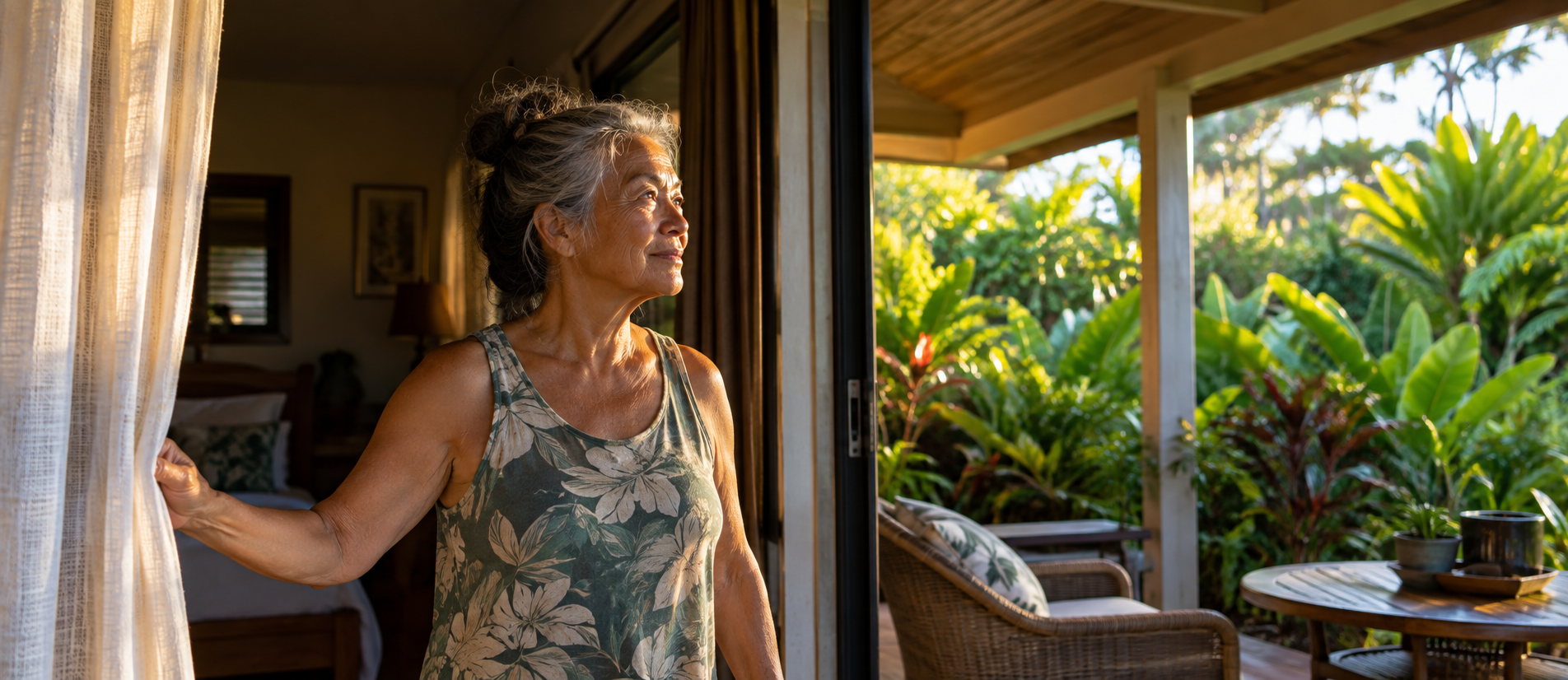
Blue light has acquired a bad reputation. It is blamed for poor sleep, tired eyes and nearly every problem associated with using a screen after dark.
But blue light is not inherently harmful. It is an important part of daylight, and your body uses it as one of its strongest signals that the active part of your day has begun.
The problem is not simply blue light. The problem is receiving a strong “daytime” signal when your body should be preparing for sleep—or failing to receive enough of that signal during the hours when you need to be awake.
That makes timing more useful than fear.
Your eyes do more than help you see
Light entering your eyes does not only create vision. Specialized cells in the retina also send information to the part of the brain that coordinates your circadian rhythm—your internal timing system.
That system helps organize:
- when you feel alert or sleepy;
- when melatonin rises;
- daily changes in body temperature;
- the timing of hormone release;
- appetite and metabolism; and
- many other processes that follow a roughly 24-hour pattern.
Blue-rich light is especially effective at signaling daytime. During your waking hours, that can be useful. It can increase alertness, reduce sleepiness and reinforce the timing of your internal clock.
Near bedtime, the same signal may delay the rise in melatonin, make you feel more alert and shift sleep later than you intended.
The light has not changed. Your biological need has.
If you sleep at night, reduce blue-rich light before bed
For most people, nighttime is when blue light becomes a problem because nighttime falls immediately before their intended sleep period. During the final two to three hours before bed, begin reducing blue-rich overhead LEDs, bright bathroom and kitchen lighting, televisions, computers, tablets and phones.
You do not need to eliminate every trace of blue light after sunset. The goal is to stop sending your brain a strong daytime signal while it is preparing for sleep. Warmer, dimmer room lighting, lower screen brightness and less time with a bright device close to your face can help create that transition.
If you work at night and sleep during the day, however, the clock tells a different story. Blue-rich light early in the night may support alertness because it occurs near the beginning of your waking period. This is why “avoid blue light at night” is incomplete advice. The more useful rule is: use blue-rich light near waking and reduce it near sleep.
“Morning” is biological—not merely a time on the clock
For someone who sleeps at night and wakes at 7:00 a.m., biological morning and clock morning generally coincide.
For a nurse who finishes work at 7:00 a.m. and plans to sleep at 9:00 a.m., bright morning sunlight arrives during her biological evening. It may make the trip home safer by increasing alertness, but it can also make the transition to daytime sleep more difficult.
For a worker who wakes at 6:00 p.m. before an overnight shift, early evening may function as biological morning. Blue-rich light at that time can help signal that the active period has begun. The same light used near the end of the shift may make daytime sleep harder.
This is why universal advice such as “get morning light” can be confusing. A more useful rule is:
Use blue-rich light near the beginning of your waking period. Reduce it as you approach your intended sleep period.
Can you create a blue-light “morning” after dark?
Yes. If daylight is still available when you wake, spending time outdoors, on a lanai or near a bright window gives you a naturally blue-rich light signal. If it is already dark, you can create that signal indoors.
One option is to install bright blue-enriched white LED bulbs, commonly sold as “daylight” bulbs in the 5,000–6,500 K range, in the room where you get ready for work. They produce white-looking light with a stronger blue component than warm-white household bulbs. Using more than one fixture can make the entire room brighter and place the light throughout your field of vision.
Another option is a purpose-built blue-light device. The circadian system is particularly responsive to wavelengths around 480 nanometers, and some devices use blue LEDs near 470–480 nm. Look for a product that identifies its wavelength, tells you the distance at which it should be used and provides an exposure schedule. A decorative bulb that merely looks blue may not provide enough circadian-effective light to accomplish anything useful.
“10,000 lux” is commonly advertised for white-light boxes, but lux describes how bright light appears to human vision. It does not fully describe the biological strength of a narrow-band blue device. For blue light, wavelength, output at the eyes, distance and duration all matter. Follow the specifications for the particular device rather than assuming that any blue bulb will work.
Use blue-rich light after waking and during the earlier part of the shift. During the later part of the shift, begin reducing blue-rich overhead light and screen brightness when the work allows it. The aim is not to remain under strong blue light all night. It is to create a clearer beginning and ending to the worker’s biological day.

A phone is not the only evening light that matters
Advice about blue light often focuses almost entirely on phones, tablets and computers. Screens matter because they are bright, close to the eyes, engaging and often used for long periods. But they are not the only source of a biological daytime signal after dark.
Overhead LED fixtures, bright bathroom lights, televisions and a brightly illuminated kitchen can all contribute to evening light exposure. A phone set to night mode does not cancel a room filled with bright light.
The total effect depends on several factors:
- Timing: Light closer to your usual sleep period may be more disruptive.
- Brightness: A brighter source generally sends a stronger signal.
- Duration: Five minutes and two hours are not the same exposure.
- Distance: A screen or lamp close to your eyes can have more effect than a dim source across the room.
- Wavelength: Blue-rich light is particularly effective at influencing the circadian system.
- Your sensitivity: People vary considerably in how strongly their bodies respond to evening light.
This is why two people can follow the same screen routine and report very different sleep experiences.
Night mode helps—but it does not turn nighttime into daytime safely
Night-mode settings shift a screen toward warmer colors and reduce some blue light. They may be useful, particularly when combined with lower brightness.
But night mode has limits. It does not make a bright screen dark. It does not shorten the time you spend scrolling. It does not remove the mental stimulation of news, work, games or conversation. And it does not dim the rest of the room.
If sleep is the goal, the strongest approach is usually a combination:
- lower the screen brightness;
- use the warmer night setting;
- dim overhead and bathroom lights;
- hold screens farther from your face when practical;
- reduce highly stimulating content; and
- stop using the device earlier when you notice that it delays sleep.
You do not have to make your home completely dark at sunset. The goal is to create a gradual transition from active daytime lighting to a quieter nighttime environment.
Daytime light may be the missing half of the conversation
Some people work hard to eliminate blue light at night while spending most of the day indoors under relatively dim lighting.
That can weaken the contrast between day and night. Your circadian system benefits from a clear pattern: brighter days and darker nights.
Outdoor light is usually much brighter than ordinary indoor lighting, even when the sky is cloudy or you are standing in open shade. Time outside after waking can therefore provide a stronger daytime signal than simply sitting beside a lamp.
Daytime light exposure may become especially important with age. Older adults often spend less time outdoors, and changes in the eye can reduce the amount of light reaching the retina. A deliberate daytime-light routine may help reinforce alertness during the day and the timing of sleep later.
You do not need to stare at the sun—and should not. You only need to place yourself in a naturally bright environment while protecting your eyes and skin appropriately.
Blue-blocking glasses are a tool, not a requirement
Blue-blocking glasses can reduce short-wavelength light reaching the eyes. Some people find them useful during the hours before sleep, especially when they cannot control workplace or household lighting.
Their usefulness depends on the situation. Clear lenses that block only a small portion of blue light may have a modest effect. Darker amber or orange lenses generally block more, but they also change color perception and may be inconvenient.
Blue-blocking glasses are not a substitute for bright daytime light, an appropriate sleep schedule or a darker sleep environment. They are best viewed as one possible layer of control when evening light cannot otherwise be reduced.
A practical light plan for a conventional schedule
If you generally sleep at night:
- After waking: Open curtains and spend some time in outdoor light or open shade when practical.
- During the day: Work in a reasonably bright environment rather than remaining in dim light all day.
- Two to three hours before bed: Begin lowering unnecessary room brightness.
- During the final hour: Use warmer, lower lighting and reduce screen brightness and stimulation.
- During sleep: Keep the bedroom as dark as practical. If you need a safety light, use the lowest level that allows safe movement.
You do not have to execute every step perfectly. The pattern matters more than one isolated exposure.
A practical light plan for night-shift work
If you work overnight, your strategy must account for alertness at work and sleep after sunrise:
- After waking: Use remaining daylight, blue-enriched white lighting or a purpose-built blue-light device to signal the beginning of your active period.
- Early in the shift: Continue working in a blue-rich, well-lit environment when possible, particularly if alertness is a safety issue.
- Late in the shift: Begin reducing unnecessary blue-rich light if your work allows it.
- On the trip home: Consider how much morning light you receive. Dark glasses may reduce the alerting signal, but they must never interfere with safe driving.
- At home: Keep the environment dim as you prepare for sleep.
- During daytime sleep: Use blackout curtains, an eye mask or both to create a convincing biological night.
Rotating shifts are harder because the body cannot fully adapt before the schedule changes again. In that situation, light can help, but it cannot erase the biological cost of constantly moving sleep.
Look at your entire light day
If you struggle to fall asleep, wake too early, feel sleepy during the day or never feel fully alert, do not look only at your bedtime.
Ask:
- How much outdoor or bright light do I receive after waking?
- Do I spend most of my daytime hours in a dim room?
- When does my home become darker and quieter?
- Are the brightest lights in my day occurring close to bedtime?
- Is my sleep schedule consistent enough for my body to recognize a pattern?
The answer may not require an expensive device. It may begin with curtains opened earlier, blue-enriched light near the beginning of your waking period and fewer blue-rich signals as sleep approaches.
Note from Marsha
Blue light is a good example of why health advice can become misleading when we divide everything into “good” and “bad.” Your body needs light. The important question is whether the light you receive matches what you are asking your body to do next.
Begin by paying attention to the rhythm of light across your entire day. A blue-light device can be useful when natural light is unavailable, but it works within that larger pattern—not in place of it.
Sources
- Duffy JF, Czeisler CA. Effect of Light on Human Circadian Physiology. Sleep Medicine Clinics. 2009.
- Brown TM, et al. Recommendations for Daytime, Evening, and Nighttime Indoor Light Exposure to Best Support Physiology, Sleep, and Wakefulness in Healthy Adults. PLOS Biology. 2022.
- Blume C, Garbazza C, Spitschan M. Effects of Light on Human Circadian Rhythms, Sleep and Mood. Somnologie. 2019.
- Silvani MI, Werder R, Perret C. The Influence of Blue Light on Sleep, Performance and Wellbeing in Young Adults: A Systematic Review. Frontiers in Physiology. 2022.
- Dautovich ND, et al. A Systematic Review of the Amount and Timing of Light in Association with Objective and Subjective Sleep Outcomes in Community-Dwelling Adults. Sleep Health. 2019.
- Figueiro MG, et al. Light, Sleep and Circadian Rhythms in Older Adults with Alzheimer's Disease and Related Dementias. Neurodegenerative Disease Management. 2017.
- West KE, et al. Blue Light from Light-Emitting Diodes Elicits a Dose-Dependent Suppression of Melatonin in Humans. Journal of Applied Physiology. 2011.
- National Institute for Occupational Safety and Health. Training for Nurses on Shift Work and Long Work Hours: The Color of Light and Coping with Night and Evening Shifts.
Share This: