Guides

Make the Most of Your Doctor Visit: Prepare with AI

Take Control of Your Health!

A person reviews printed health results and writes appointment notes beside an open laptop.

You finally have an appointment with your doctor, but the question you most wanted to ask slips your mind. You remember another concern on the drive home, and you're not quite sure what the next step is. The visit happened, yet some of the understanding you needed never happened.


Your time and your doctor's time are valuable. Arriving prepared helps you get more from that limited opportunity to work together. You don't need to know your diagnosis beforehand. You need a clear account of what's happening, your most important questions, and a way to leave with a plan you understand.


AI can help with that preparation, especially when the subject is unfamiliar. It can explain terminology, organize your records, suggest possible explanations, and help you discover questions you wouldn't have known to ask. But if you know very little about a subject, how do you recognize a convincing answer that's wrong?


This Guide gives you a practical process for both: preparing for your appointment and using AI thoughtfully along the way.


Download: Your Doctor Visit Worksheet (PDF)


Use page one before your visit. Bring page two to record what you discuss, what you decide, and what happens next.


You can use the worksheet with or without AI.


1. Start with what you want to accomplish


Before opening an AI conversation, ask yourself what you want help with. Is there a new symptom? A change in your test results? A medicine that's causing difficulties? Are you trying to understand an existing diagnosis or decide between options?


Choose up to three priorities, with the most important first. The aim isn't to squeeze every concern into one visit. It's to give you and your doctor a clear starting point and identify what might need another appointment.


Ask AI: “Help me organize these concerns into three appointment priorities. Ask what matters most to me, and don't assume which concern should come first.”


At the beginning of the visit, you might say: “The main thing I want help with is this. I also have two other questions. What can we cover today?” That makes your concerns visible while there's still time to address them.


2. Gather your facts before looking for explanations


Write down what you've noticed, when it began, how often it happens, and whether it's changing. Include what seems to bring it on or relieve it, what you've tried, and how it affects your daily life.


“I'm tired” is a starting point. “For three weeks, I've needed to rest after grocery shopping, which I previously finished without stopping” gives a clearer picture of the change.


Gather your medicines and supplements, including doses, how often you actually take them, recent changes, allergies, and previous reactions. Include relevant test reports and advice from other clinicians. Practical difficulties matter too: cost, side effects, confusing instructions, or a plan that doesn't fit your life.


Ask AI: “Organize this information into a brief factual timeline. Separate what I've observed from possible explanations. Don't add symptoms or fill gaps with assumptions.”


Read the result yourself. You can judge whether it accurately describes your experience even if you can't judge the medical explanation.


3. Use your results to develop focused questions


Sharing test results gives AI something concrete to discuss. Include the dates, values, units, and the laboratory's reference ranges, along with why the tests were ordered and relevant symptoms and history. Earlier reports may help you explore changes over time.


If you upload a report, first ask AI to list the important results exactly as written. Compare that list with the original. A wrong decimal point, unit, date, or reading of a scanned page can change everything that follows. Remove identifying details that aren't needed, and check the service's current privacy settings before sharing health records.


Then ask for a focused assessment:


“Explain what these results show directly and what remains uncertain. Ask for missing information that could change the interpretation. Based on what I've provided, what is the leading possible explanation, and what are two or three relevant alternatives? If the information doesn't support ranking them, say so. Include any important alternative that would change how urgently I should seek care.”


You don't need a catalogue of every possible disease. You do need to avoid treating the first plausible explanation as settled. Some findings support a diagnosis strongly; others have several possible causes or make sense only alongside an examination and other information.


Follow with: “What supports the leading explanation, what doesn't fit, and what information would make you reconsider it? Ask me the questions that would help distinguish these possibilities, a few at a time.”


This is how the next questions begin to emerge. You don't have to invent them from knowledge you don't yet have.


Worked example: turn a finding into a question


Fictional example, not a diagnosis: A report flags a result below its reference range, and you've also noticed fatigue. AI suggests a possible deficiency.


Start by checking whether it read the value, units, and range correctly. Then ask whether that result establishes the deficiency or merely raises the possibility. Ask which other results, symptoms, or history would help distinguish that explanation from alternatives.


The appointment question becomes: “Does this result help explain my fatigue? What would establish the cause, and what should we do next?”


You've turned a vague concern into a useful discussion without pretending you've established the diagnosis yourself.


4. Judge what you can, and identify what you can't


When your knowledge is slim, don't make confidence your test of accuracy. A clear explanation can help you understand an idea while leaving its correctness unresolved.


You can check whether AI used your facts accurately, whether it contradicted itself, and whether its cited source says what it claims. Judging how much weight a study deserves or whether a diagnosis fits your individual circumstances can require relevant expertise.


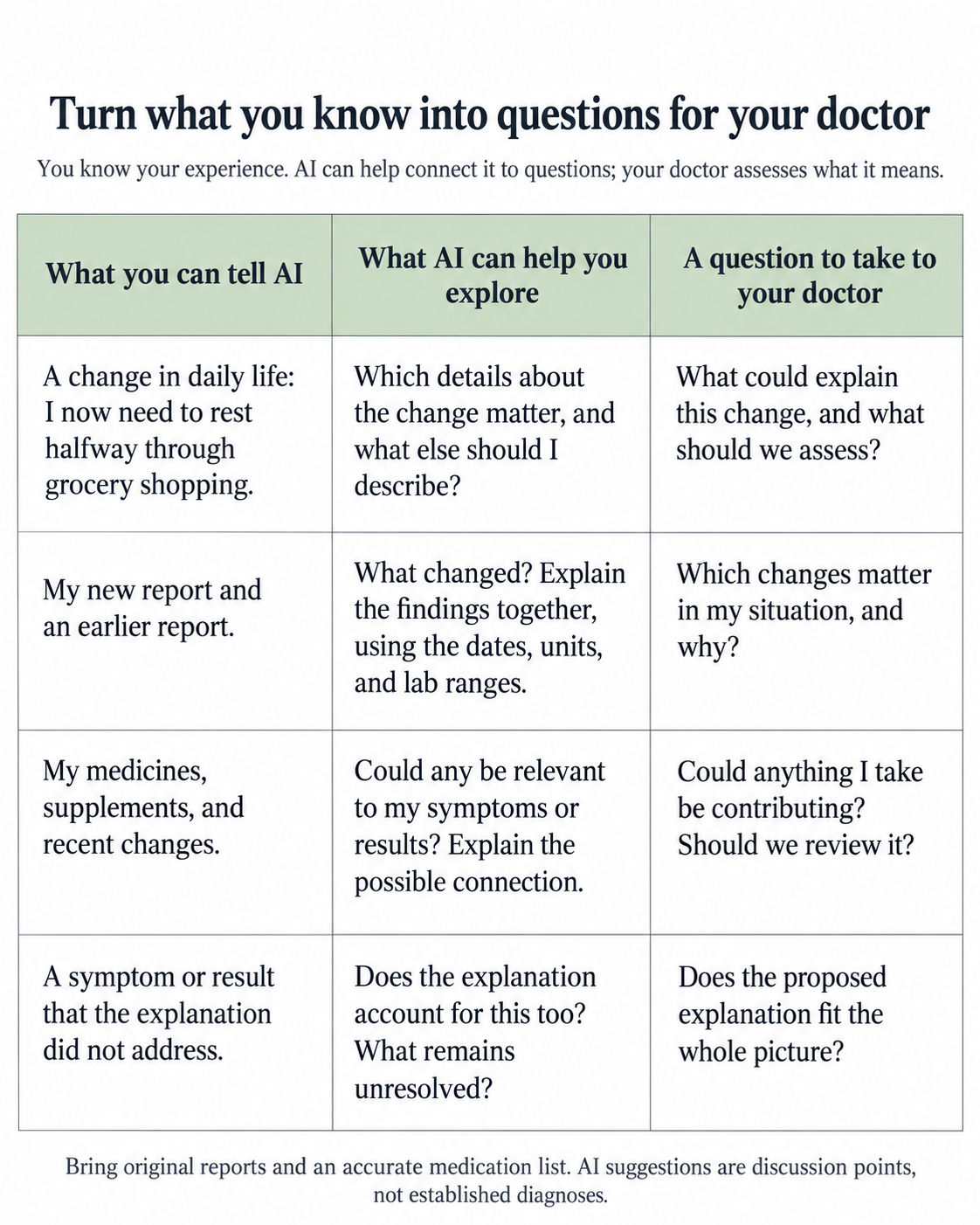
You don’t need medical training to describe what’s changed in your life or provide your reports and medication history. These examples show how AI can help you explore that information and develop questions for your doctor.

If you can't tell whether a claim is supported, mark it unverified. That is useful information about where you need help, not a failure on your part.

Table showing how changes in daily life, test reports, medication history, and unexplained findings can become questions for a doctor.

Worked example: a genuine source, an unsupported claim


Fictional teaching example: AI says, “Supplement X improves memory in people.” The cited study describes a change in a laboratory marker in mice.


The source may be real, but it doesn't establish the claimed memory benefit in people. You don't need to understand every laboratory method to notice the difference in who was studied and what was measured.


Ask AI: “Which passage supports the specific claim? Separate what the source directly reports from your interpretation.”

Open the source and check. If it's a human trial, you may still need help assessing its design and relevance. A 2025 study found that the AI models it tested often cited medical sources that didn't fully support their answers. Those findings concern the models and questions tested, not a fixed error rate for every tool today. [1]


5. Use uncertainty to generate better questions


Ask AI to explain a term in plain language, compare possible explanations, or identify what another test would clarify. Ask how a previous diagnosis fits the information and what remains unexplained.


Useful prompts include:


  • “Compare these reports. What changed, and are the units and testing conditions comparable?”
  • “Could my medicines or supplements be relevant? What should I ask my pharmacist or prescriber?”
  • “What question would this proposed test answer, and how could the result change the next step?”
  • “What am I assuming that might be wrong?”
  • “You changed your answer. Which new fact or specific error changed your conclusion?”


Agreement from a second chatbot, repeated reassurance, or a confidence percentage isn't independent confirmation. For a consequential action, check the basis beyond the AI conversation. Medication changes belong in a discussion with your prescriber or pharmacist; a reassuring chat shouldn't delay care for potentially urgent symptoms.


6. Arrive with a short summary, not a stack of AI answers


Use your worksheet to bring three priorities, a brief account of the problem, relevant results, and the questions you want answered. Keep full reports and a complete medication list available separately.


Ask AI: “Create a concise appointment summary from the facts we've confirmed. Include my priorities, symptom timeline, relevant results, and questions. Label possible explanations as possibilities. Don't describe an AI suggestion as a diagnosis.”


Check dates, doses, units, and wording before printing. If AI helped you develop a question, you can say: “I used AI to understand this report, and it raised this possibility. Does it fit my situation?” You don't need to defend the suggestion. You want it assessed.


The National Institute on Aging recommends prioritizing concerns and bringing relevant information, including medicines and doses, to the visit. [2] If useful, a trusted companion can help you remember or take notes. Ask for an interpreter or other communication support if you need it.


7. Get value from the decisions, not just the discussion


When your doctor proposes a test or treatment, ask what it's intended to accomplish. Getting the biggest bang for the buck means understanding which steps serve your goals, rather than simply doing more.


Choose the questions relevant to the decision:


  • “What are we trying to find out or improve?”
  • “How would this test result change what we do?”
  • “What benefit should I expect, and over what period?”
  • “What are the main drawbacks and reasonable alternatives?”
  • “Is monitoring an option? What would make waiting inappropriate?”
  • “How does this fit my other conditions, medicines, budget, and daily life?”


Tell your doctor if the plan isn't workable. That gives you a chance to discuss an alternative while you're together. The Agency for Healthcare Research and Quality encourages patients to ask about options and explain difficulties following instructions. [3]


8. Leave knowing what happens next


Before the visit ends, put the plan into your own words: “Let me make sure I've got this right.” Confirm the next action, how and when you'll receive results, when to follow up, and what changes should prompt earlier contact.


If a concern wasn't covered, ask how it will be addressed. Write the next steps on page two of your worksheet, and request written instructions when helpful.


Afterward, AI can organize your notes into an action list. Ask it to preserve the instructions and flag gaps rather than fill them in. Compare its summary with the clinician's instructions, and contact the office about anything unclear or contradictory. Keep track of expected results; silence doesn't tell you what they showed.


Your first step can be small


If this feels like a lot, begin with your main concern, a short symptom timeline, and your current medication list. Add three questions you want answered. That's already a more useful starting point than relying on memory once you're in the examination room.


Taking control of your health doesn't mean taking on every medical judgment yourself. It means bringing your experience into the conversation, understanding the decisions, and knowing what you'll do next. AI can help you prepare for that role, with the uncertainties made visible.


Download: Your Doctor Visit Worksheet (PDF)


Prepare on page one. Record your plan on page two. Keep it for the next conversation.


Sources

  1. Wu K, Wu E, Zou J. “An automated framework for assessing how well LLMs cite relevant medical references.” Nature Communications, 2025. Publication and abstract.

  2. National Institute on Aging.  How To Prepare for a Doctor's Appointment.

  3. Agency for Healthcare Research and Quality. Be More Engaged in Your Healthcare.


Note from Marsha


I value AI because it gives me time to explore questions and work toward understanding. But I've also received excellent explanations of mistakes only after I've caught them. If I hadn't noticed that something didn't fit, I might have accepted the original answer.


I want people to get more from both AI and their medical appointments. Your time matters, and so does your doctor's. Preparation helps you use that time for the concerns and decisions that matter most to you. You don't have to arrive with all the answers. Arrive ready to take part.


Where You Might Want to Go Next


When Understanding Doesn't Fit in the Appointment Slot
Explore why getting answers during an appointment isn’t always the same as having time to understand them.


The AI Revolution in Disease Diagnosis: Are We Ready?
Look at how AI is changing disease diagnosis and what that could mean for your care.


AI-Driven Drug Repurposing: A New Hope for Thousands of Rare Diseases
Discover how AI could help find new uses f
or existing medicines, particularly for diseases with few treatment options.