The Financial Trade-Off: Premiums vs. Financial Exposure
Medicare Advantage plans often attract attention because many offer a $0 additional plan premium. But that doesn't mean Medicare coverage is free. Beneficiaries generally still pay their Part B premium, and they may owe deductibles, copayments, and coinsurance as services are used.
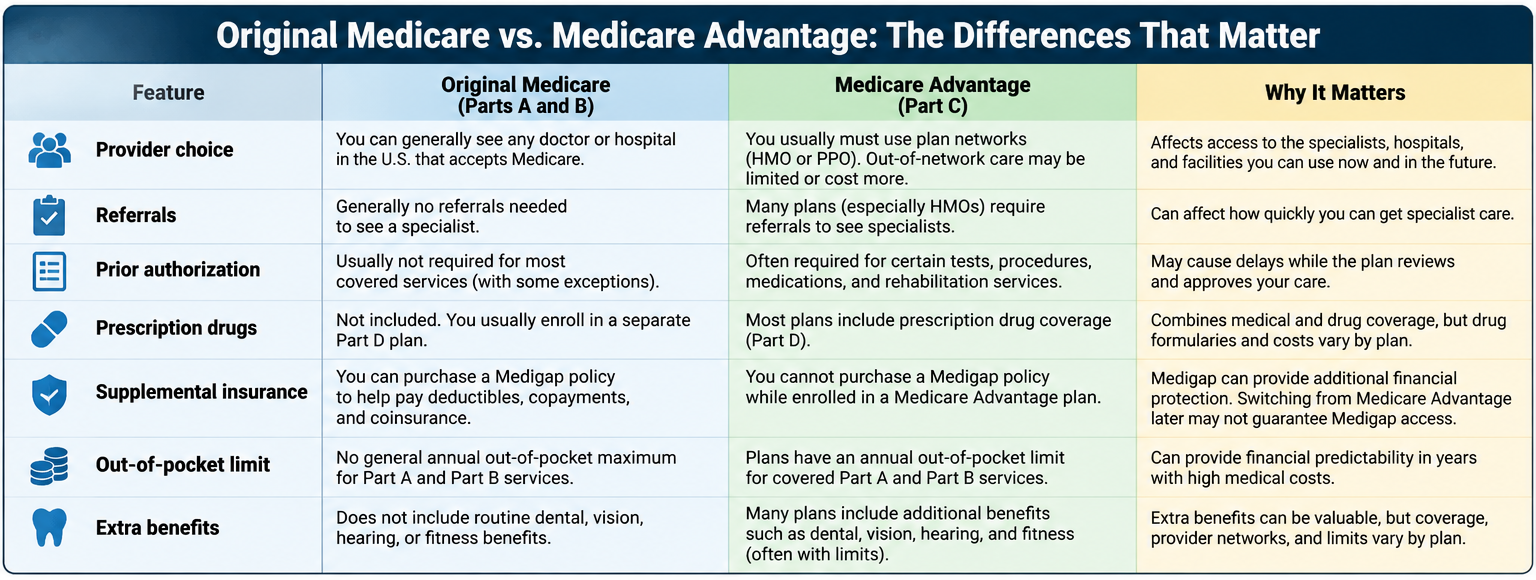
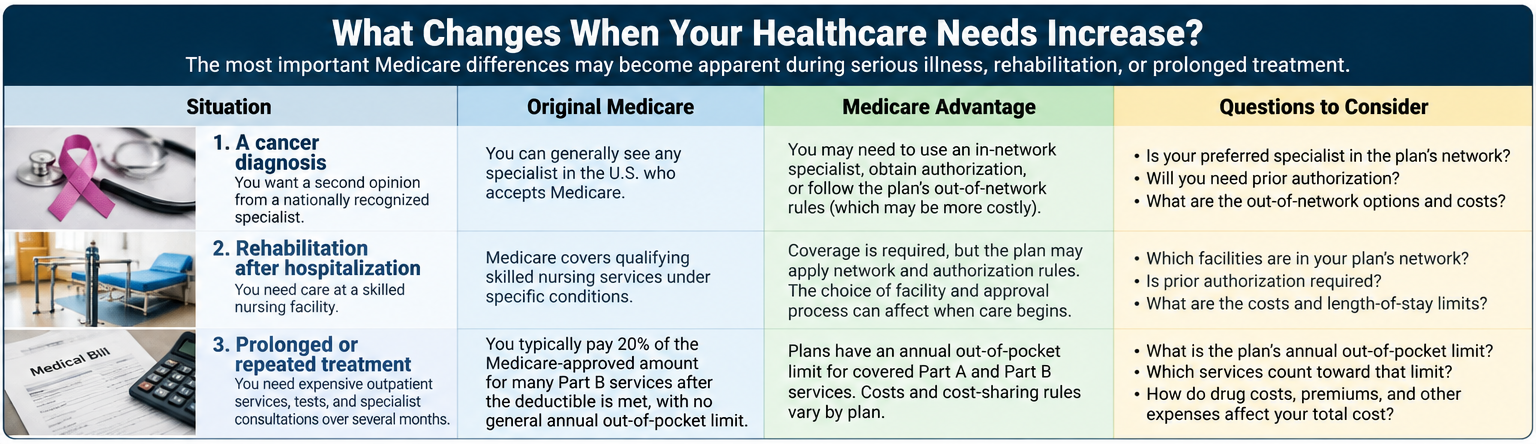
One important advantage is that Medicare Advantage plans have an annual out-of-pocket limit for covered Medicare Part A and Part B services. Once a beneficiary reaches the applicable limit, the plan pays the covered costs governed by that limit for the remainder of the year. Prescription drug expenses, premiums, and other costs follow separate rules.
Original Medicare generally requires beneficiaries to pay 20% of the Medicare-approved amount for many Part B services after the deductible is met. It doesn't provide the same general annual out-of-pocket maximum.
That's one reason many people using Original Medicare purchase a Medigap policy. Medigap can pay certain deductibles, copayments, and coinsurance according to the policy selected.
But Medigap requires its own premium, and Original Medicare beneficiaries who want prescription coverage generally obtain a separate Part D plan.
Consequently, a comparison of monthly premiums alone can be misleading.
Someone who uses few medical services might spend less under one arrangement, while someone requiring expensive, continuing treatment might have a very different experience.
The appropriate comparison considers the total annual cost of premiums, expected services, cost-sharing, and the financial exposure created by a particularly expensive year.
Medicare Advantage's Extra Benefits: How Valuable Are They?
Dental, vision, hearing, fitness, and other supplemental benefits can be attractive. Original Medicare generally doesn't cover routine dental treatment, standard eye exams for eyeglasses, or hearing aids.
But extra benefits need to be examined carefully.
A dental benefit might provide a limited annual allowance, cover preventive services more generously than major dental work, or require the use of particular dentists. Hearing benefits may have similar restrictions involving providers, products, and payment limits.
That doesn't make the benefits unimportant. For someone who uses them, they can provide meaningful savings.
But a benefit described in a brochure isn't necessarily equivalent to comprehensive coverage. The important questions are how much the plan pays, which services qualify, which providers participate, and what the patient must contribute.
It's worth evaluating those details rather than treating the presence of a benefit as evidence that one plan provides better overall protection.
The Medigap Issue Many People Discover Too Late
There's another difference that deserves special attention because it can affect someone's ability to change coverage later.
A person can generally change between Medicare Advantage plans or return to Original Medicare during applicable enrollment periods.
However, returning to Original Medicare doesn't necessarily guarantee access to a Medigap policy.
Federal law provides a six-month Medigap open enrollment period, generally beginning when someone is at least 65 and enrolled in Part B. During that period, insurers generally can't refuse a Medigap policy because of health conditions.
Outside that period, federal protections are more limited. Certain situations provide guaranteed-issue rights, and some states offer additional protections. Otherwise, insurers may use medical underwriting, charge more based on health history, or decline to issue a policy where permitted.
This matters because someone may spend years in Medicare Advantage, develop significant health problems, and then decide they want Original Medicare's broader provider access.
They may be able to return to Original Medicare but discover that obtaining supplemental coverage is difficult or expensive.
That creates a potentially important trade-off between choices that appear attractive today and options that may be available in the future.
Before leaving a Medicare Advantage plan with the intention of purchasing Medigap, confirm your actual eligibility and available protections. Don't assume approval is automatic.
What About People Living in Hawaii?
For Hawaii residents, the basic Medicare choices are governed by federal Medicare rules, but the available private plans and provider networks vary locally.
A Medicare Advantage plan may meet a person's needs well when their physicians, hospitals, and specialists are within its network.
But residents who travel frequently to the mainland, need specialized care outside Hawaii, or spend extended periods away from home may want to examine how their plan handles nonemergency services outside its regular service area.
Original Medicare generally offers broad access to participating providers throughout the United States. Medicare Advantage coverage outside the local network depends on the plan's rules, with different provisions for emergency and urgent care.
Hawaii residents considering a change involving Medigap should also check the rights and protections applicable in Hawaii rather than relying solely on general national descriptions.
Hawaii SHIP, the State Health Insurance Assistance Program, offers free Medicare counseling and can help residents understand coverage options and enrollment questions.
Can You Change Your Medicare Arrangement Later?
Medicare beneficiaries have opportunities to change coverage during designated enrollment periods.
The annual Medicare Open Enrollment Period runs from October 15 through December 7. During this period, eligible beneficiaries can make certain changes to Medicare Advantage and Part D coverage for the following year.
People already enrolled in Medicare Advantage also have a separate Medicare Advantage Open Enrollment Period from January 1 through March 31, during which they can make certain changes, including returning to Original Medicare.
Other circumstances may qualify someone for a Special Enrollment Period.
However, as we've discussed, changing Medicare coverage and obtaining supplemental insurance are not necessarily the same decision.
Before changing plans, confirm that your physicians participate, that your medications are covered, that the plan serves your area, and that any supplemental coverage you need is available.
The right to change coverage is valuable, but changing without understanding the financial and medical consequences can create new problems.
Questions Worth Asking Before Choosing
Rather than assuming that one Medicare arrangement is best for everyone, consider the care you're likely to need and the degree of flexibility you want to preserve.
Ask yourself whether seeing particular physicians or specialists is important, whether you travel or spend time outside your home area, and whether you would be comfortable obtaining advance approval for certain services.
Consider both your routine medical expenses and the possibility of a serious illness. How would a hospitalization, rehabilitation stay, or prolonged course of treatment affect your finances under each arrangement?
And don't overlook the long-term question. If you want to change coverage several years from now, what options are likely to remain available?
No one can predict every future medical need. But understanding the structural differences between the two arrangements can help you identify which trade-offs matter most.
Looking Beyond the Monthly Premium
Original Medicare and Medicare Advantage provide two different ways to receive Medicare-covered healthcare.
Original Medicare generally offers broader provider choice and fewer prior authorization requirements, but without supplemental coverage it can expose beneficiaries to substantial cost-sharing.
Medicare Advantage offers structured networks, an annual out-of-pocket limit for covered Medicare services, and often additional benefits. But it can also involve greater restrictions on provider choice and advance approval for certain services.
The important distinction isn't that one system is good and the other is bad. It's that they distribute financial risk, administrative responsibilities, and freedom of provider choice differently.
The Medicare arrangement that works well when you're healthy isn't necessarily the one you'll prefer when your medical needs become complicated. Understanding that possibility before it happens may be one of the most useful parts of making an informed Medicare decision.
Sources and Further Reading
Medicare.gov: Compare Original Medicare and Medicare Advantage
https://www.medicare.gov/basics/get-started-with-medicare/get-more-coverage/your-coverage-options/compare-original-medicare-medicare-advantage
Medicare.gov: Medicare Costs
https://www.medicare.gov/basics/costs/medicare-costs
Medicare.gov: When Can I Buy a Medigap Policy?
https://www.medicare.gov/health-drug-plans/medigap/ready-to-buy/when
Medicare.gov: Learn How Medigap Works
https://www.medicare.gov/health-drug-plans/medigap/basics/how-medigap-works
Hawaii SHIP: Medicare Counseling and Assistance
https://www.hawaiiship.org/