

Health Resource
What Swollen Feet Can Tell You About Your Health
How the pattern of swelling can help you decide what to watch, what to report, and when to seek help
Swollen feet and ankles are common, especially after you have been sitting or standing for a long time. Heat, travel, a salty meal, or a minor injury can also leave your shoes feeling tighter than usual.
Sometimes the explanation is simple and the swelling disappears. At other times, swelling can be a sign that your veins are not returning blood effectively, your body is retaining fluid, your lymphatic system is not draining properly, or an underlying health condition needs attention.
Swollen feet are a symptom, not a diagnosis. The most useful clues are usually not the swelling alone, but its pattern:
- Is one foot or leg swollen, or are both affected?
- Did it appear suddenly or gradually?
- Is the area painful, red, warm, or discolored?
- Does the swelling improve overnight or when you elevate your legs?
- Are you also experiencing shortness of breath, chest discomfort, fever, or rapid weight gain?
- Did the swelling begin after travel, prolonged inactivity, injury, illness, surgery, or a medication change?
These observations cannot tell you the cause with certainty, but they can help you recognize when swelling deserves medical attention.
What is edema?
Edema is the medical term for swelling caused by fluid accumulating in body tissues. It most commonly appears in the feet, ankles, and lower legs because gravity draws fluid downward.
You may notice that your shoes or socks feel unusually tight, your ankle bones are harder to see, or the skin appears stretched or shiny. Pressing gently on the swollen area may leave an indentation that remains for several seconds. This is called pitting edema. Other types of swelling do not leave an indentation.
Whether swelling pits is one piece of information, but it does not identify the cause. A clinician will also consider where the swelling occurs, how quickly it developed, what makes it better or worse, and whether other symptoms are present.
Begin with one foot or both
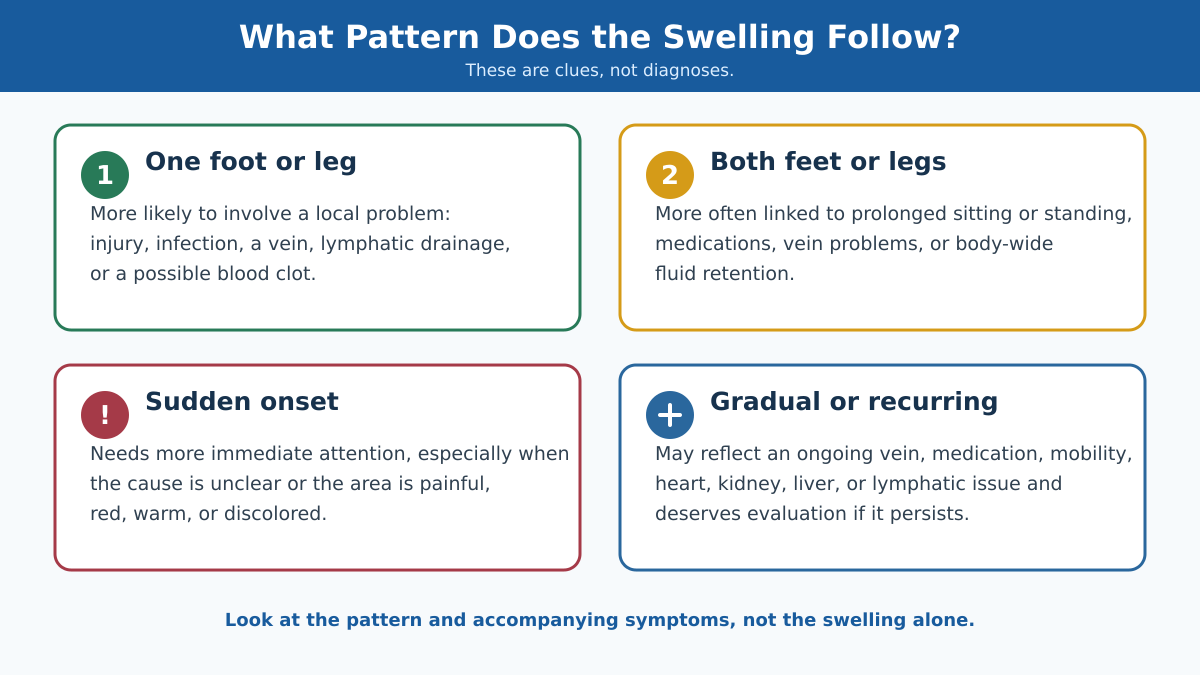
One of the most helpful first questions is whether the swelling affects one side or both.
When one foot or leg is swollen
One-sided swelling is more likely to arise from a problem in that particular leg. Possible explanations include:
- An ankle or foot injury
- Infection or inflammation
- A problem with a vein
- Impaired lymphatic drainage
- A blood clot in a deep vein
A deep vein thrombosis, or DVT, commonly forms in a deep vein of the lower leg, thigh, or pelvis. Possible symptoms include swelling, pain or tenderness, cramping, warmth, redness, or a change in skin color. However, some blood clots cause few noticeable symptoms.
New swelling in one leg deserves prompt attention when there is no clear explanation, particularly if it appeared suddenly or is accompanied by pain, warmth, redness, or discoloration.
When both feet or legs are swollen
Swelling on both sides is more commonly associated with something affecting the body more generally. Possibilities include:
- Sitting or standing in one position for a long time
- Hot weather
- High sodium intake
- Certain medications
- Chronic problems with the veins
- Reduced mobility
- Conditions affecting the heart, kidneys, or liver
This distinction is not absolute. A local problem can occasionally affect both legs, and a body-wide condition may appear more noticeably on one side. The pattern provides direction, not a diagnosis.
Sudden swelling and gradual swelling tell different stories
Swelling that appears suddenly is generally more concerning than mild swelling that develops slowly after a long day.
Sudden swelling may accompany a blood clot, infection, injury, allergic reaction, or an abrupt change in heart or kidney function. Severe swelling, rapidly worsening swelling, or swelling accompanied by significant pain should be evaluated promptly.
Gradual swelling may develop from chronic venous insufficiency, medication effects, reduced movement, or long-term heart, kidney, liver, or lymphatic problems. It may be worse late in the day and partially improve overnight.
Gradual does not mean harmless. Swelling that repeatedly returns, progressively worsens, changes the skin, or has no clear explanation deserves medical evaluation even when it is not painful.
Common temporary explanations
Not every episode of swollen feet signals a serious illness. Fluid may collect temporarily after:
- A long flight or car ride
- Hours spent sitting at a desk
- Prolonged standing
- Hot or humid weather
- A meal unusually high in sodium
- A minor ankle or foot injury
- A day with less movement than usual
The calf muscles normally help pump blood upward through the veins. When you remain still for a long time, that assistance is reduced, allowing blood and fluid to collect in the lower legs.
Temporary swelling is more reassuring when there is an obvious explanation, both sides are affected similarly, no alarming symptoms are present, and the swelling improves with movement, rest, or elevation. If it persists or continues to return, do not assume the original explanation is still responsible.
When the veins are involved
Veins return blood from the legs to the heart. One-way valves inside the veins help prevent blood from falling backward between muscle contractions.
When these valves weaken or become damaged, blood can collect in the legs. This is called chronic venous insufficiency. It may cause:
- Swelling around the ankles and lower legs
- Aching or heaviness
- Visible or enlarged veins
- Itching or discomfort
- Brownish skin discoloration near the ankles
- Skin thickening or irritation
- Sores that are slow to heal
Venous swelling often becomes more noticeable after prolonged sitting or standing and may improve when the legs are elevated. Persistent skin changes or open sores require medical care.
When the heart, kidneys, or liver may be involved
The heart, kidneys, and liver all contribute to fluid balance.
When the heart cannot pump effectively, pressure can build in the veins and fluid may accumulate in the legs, abdomen, or lungs. Leg swelling accompanied by shortness of breath, reduced exercise tolerance, difficulty breathing while lying flat, or rapid weight gain requires medical attention.
The kidneys regulate sodium and water and remove excess fluid through urine. When kidney function declines, fluid and salt may accumulate. Swelling may appear in the feet, ankles, legs, hands, or face. Changes in urination, foamy urine, unusual fatigue, or worsening blood pressure can provide additional clues, although early kidney disease may cause no symptoms.
Advanced liver disease can also disrupt fluid balance and contribute to swelling in the legs or abdomen. A history of liver disease combined with new swelling should be reported to a clinician.
Swelling alone cannot determine which organ, if any, is involved. Evaluation may include a physical examination, medication review, blood and urine tests, heart assessment, or vascular imaging.
The lymphatic system can also cause swelling
The lymphatic system collects excess fluid from the tissues and returns it to circulation. When lymphatic vessels or lymph nodes are damaged, removed, obstructed, or unable to work effectively, fluid may accumulate and cause lymphedema.
Lymphedema can affect one or both limbs. Early swelling may be soft and may improve with elevation. Over time, it can become firmer and contribute to skin thickening, tightness, heaviness, reduced movement, or repeated infections.
Lymphedema requires proper assessment. Treatment differs from the treatment used for heart-related, kidney-related, or ordinary temporary swelling.
Your medications may be contributing
Some medications can cause or worsen swelling. These include certain:
- Calcium channel blockers used for blood pressure
- Nonsteroidal anti-inflammatory drugs, or NSAIDs
- Corticosteroids
- Estrogen or testosterone treatments
- Antidepressants
- Other medicines that affect fluid balance
The timing matters. Note whether the swelling began after starting a medication, increasing a dose, or changing your treatment.
Do not stop a prescribed medicine because you suspect it is causing swelling. Abruptly discontinuing some medications can create a more serious problem. Contact the prescribing clinician or pharmacist and ask whether swelling is a known effect and whether the treatment should be reviewed.
When swollen feet require emergency help
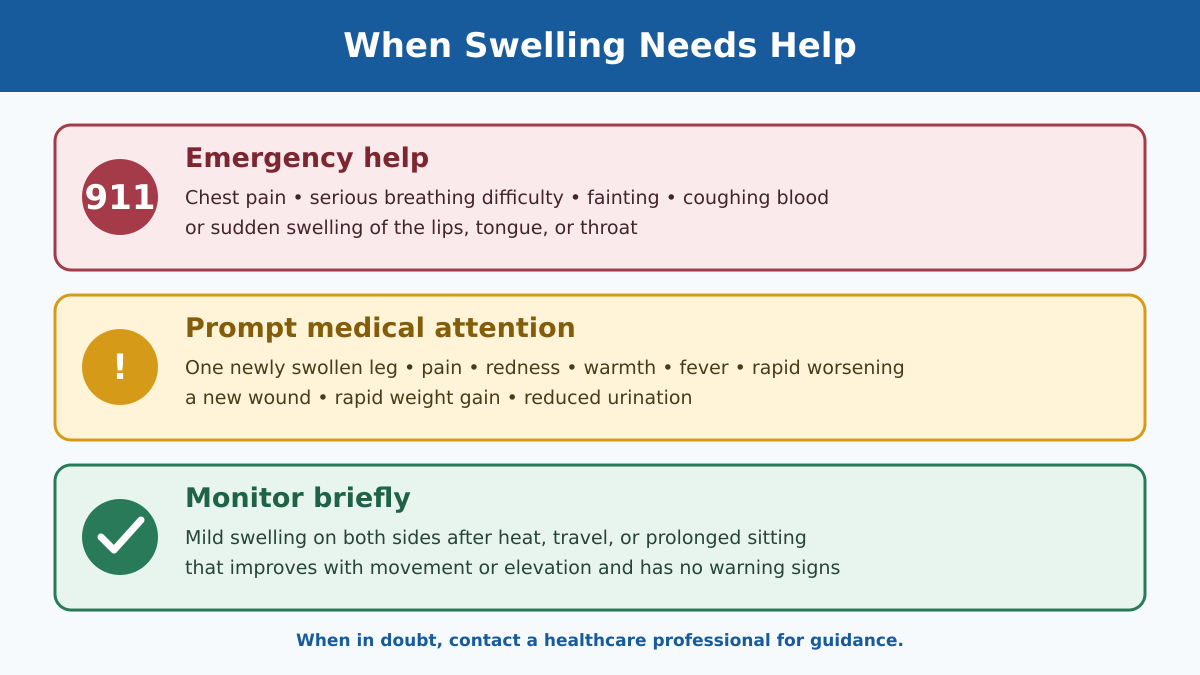
Call 911 or seek emergency care when swelling is accompanied by:
- Sudden or severe shortness of breath
- Chest pain, pressure, or tightness
- Fainting or near-fainting
- Coughing blood
- Severe breathing difficulty
- Sudden swelling of the lips, tongue, or throat
A blood clot that travels to the lungs can cause a pulmonary embolism. Symptoms may include sudden shortness of breath, pain with breathing, rapid breathing, a fast heartbeat, lightheadedness, or coughing blood.
Do not massage a suddenly swollen, painful leg or try to “walk it off” when a blood clot is possible.
When to seek prompt medical advice
Contact a healthcare professional promptly if:
- Only one foot or leg has newly swollen without an obvious explanation
- The swollen area is painful, red, warm, or discolored
- The swelling is severe, sudden, or rapidly worsening
- You have a fever or feel acutely ill
- You have diabetes and develop new foot or leg swelling
- You have heart, kidney, or liver disease and the swelling increases
- Swelling is accompanied by rapid weight gain or reduced urination
- The skin is breaking down, leaking fluid, or developing a sore
- Swelling follows a significant injury
- You are pregnant and swelling suddenly increases
Arrange a routine evaluation if swelling continues for several days, repeatedly returns, progressively worsens, or has no clear explanation.
What you can do while monitoring mild swelling
When the swelling is mild, affects both sides, has an understandable temporary cause, and is not accompanied by warning signs, several measures may help:
- Change position and move your legs regularly.
- Take walking breaks during long periods of sitting.
- Elevate your legs while lying down.
- Avoid clothing that tightly constricts the thighs or lower legs.
- Notice whether sodium intake may be contributing.
- Check your feet and skin for irritation, injury, or sores.
Compression socks help some people with venous swelling, but they are not appropriate for everyone. Significant peripheral artery disease can make compression unsafe without professional guidance. Ask before beginning compression if you have known arterial disease, diabetes with foot complications, severe swelling, skin damage, or an uncertain diagnosis.
Do not take someone else’s diuretic or increase your own dose without medical direction. Removing too much fluid can affect blood pressure, kidney function, and electrolyte levels.
What to record before contacting your clinician
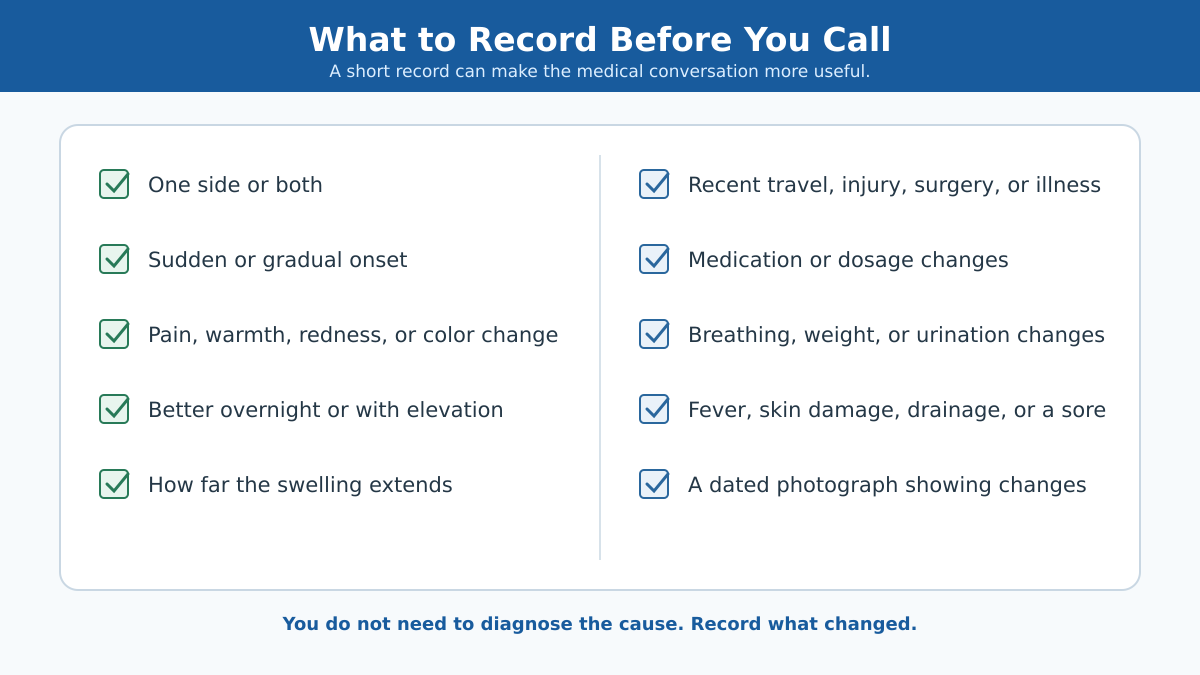
A short record can make the medical conversation more productive. Note:
- When the swelling began
- Whether it affects one side or both
- How far it extends up the leg
- Whether it appeared suddenly or gradually
- Whether it is painful, warm, red, or discolored
- Whether pressing leaves an indentation
- Whether it improves overnight or with elevation
- Recent travel, prolonged sitting, surgery, illness, or injury
- Recent medication or dosage changes
- Shortness of breath, chest discomfort, fever, weight change, or urinary changes
- Whether the skin is intact or a wound is present
A photograph taken at the same time each day may help document changes, but it cannot replace an examination.
The central question is not simply “Are my feet swollen?”
The more useful question is:
What changed, what pattern does the swelling follow, and what else is happening at the same time?
Mild swelling after a long, hot, inactive day may resolve with movement and elevation. Sudden one-sided swelling, swelling with breathing difficulty, or progressive swelling without a clear explanation requires a different response.
You do not need to diagnose the cause yourself. Your job is to notice the pattern, recognize warning signs, and seek the appropriate level of help.
This article provides general health education and is not a substitute for diagnosis or individualized medical care.