

Guides
What Really Changes When Food Is Free, Zero or Reduced?
What gluten-free, fat-free, zero sugar, reduced sodium and dairy-free foods can teach us about what’s really inside the package.
Walk through a supermarket and you see foods defined by what they don't contain.
Gluten-free bread. Fat-free milk. Zero-sugar chocolate syrup. Reduced-sodium soup. Dairy-free milk.
That invites an obvious question: If they took something out, what did they put back in?
It sounds as though there should be a fairly predictable answer. Remove fat and perhaps something else has to provide the texture. Remove sugar and another sweetener takes its place. Remove gluten and another ingredient must do its job.
Actual foods are more interesting than that.
Sometimes one ingredient is replaced by another. Sometimes several ingredients are needed because the missing ingredient was doing several jobs. Sometimes surprisingly little else changes.
And sometimes nothing was taken out in the first place.
Gluten-Free Bread Isn't Bread Minus Gluten
Bread is a good place to start because gluten isn't simply another item in the recipe.
When wheat flour is mixed with water, gluten-forming proteins create an elastic network through the dough. As yeast produces gas, that network stretches around the bubbles and helps the dough rise while still holding together.
Take away the wheat gluten and the baker hasn't merely lost an ingredient. Part of the architecture of the bread is gone.
Canyon Bakehouse Heritage Style Honey White shows what this can look like in an actual gluten-free loaf. Its formulation includes brown rice flour, tapioca flour, sorghum flour and potato starch, along with eggs and xanthagum.
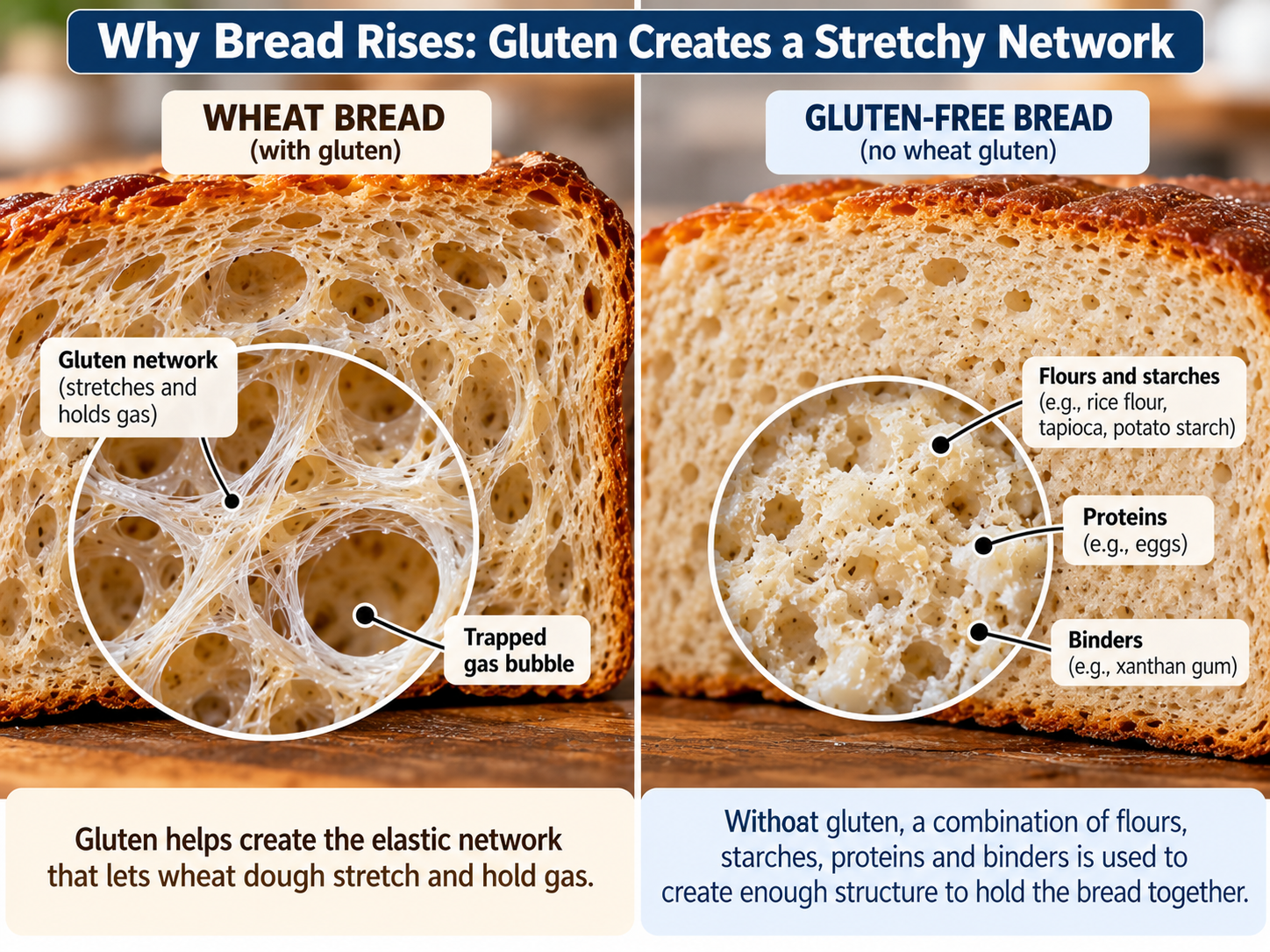
There is no single ingredient sitting there doing everything gluten once did. The loaf has been built using a combination of ingredients with different properties.
That makes the ingredient list look different. Brown rice flour, tapioca flour, potato starch, eggs and xanthan gum aren't simply a collection of mysterious additions. They are part of the engineering required to make a loaf without wheat gluten.
There can be nutritional consequences as well. One 43-gram slice of this Canyon Bakehouse bread contains 22 grams of carbohydrate and less than 1 gram of fiber.
If avoiding gluten is your concern, the bread addresses that need. If you're also limiting carbohydrate, however, the starches used in many gluten-free baked products make the final carbohydrate and fiber numbers worth checking.
The package can solve one problem without necessarily solving another.
Fat-Free Doesn't Tell You What Happened Next
Now take out fat.
Fat contributes more than calories to many foods. It can affect creaminess, mouthfeel, texture and the way flavors are experienced. What happens when it disappears depends heavily on the food.
Ranch dressing gives us one answer.
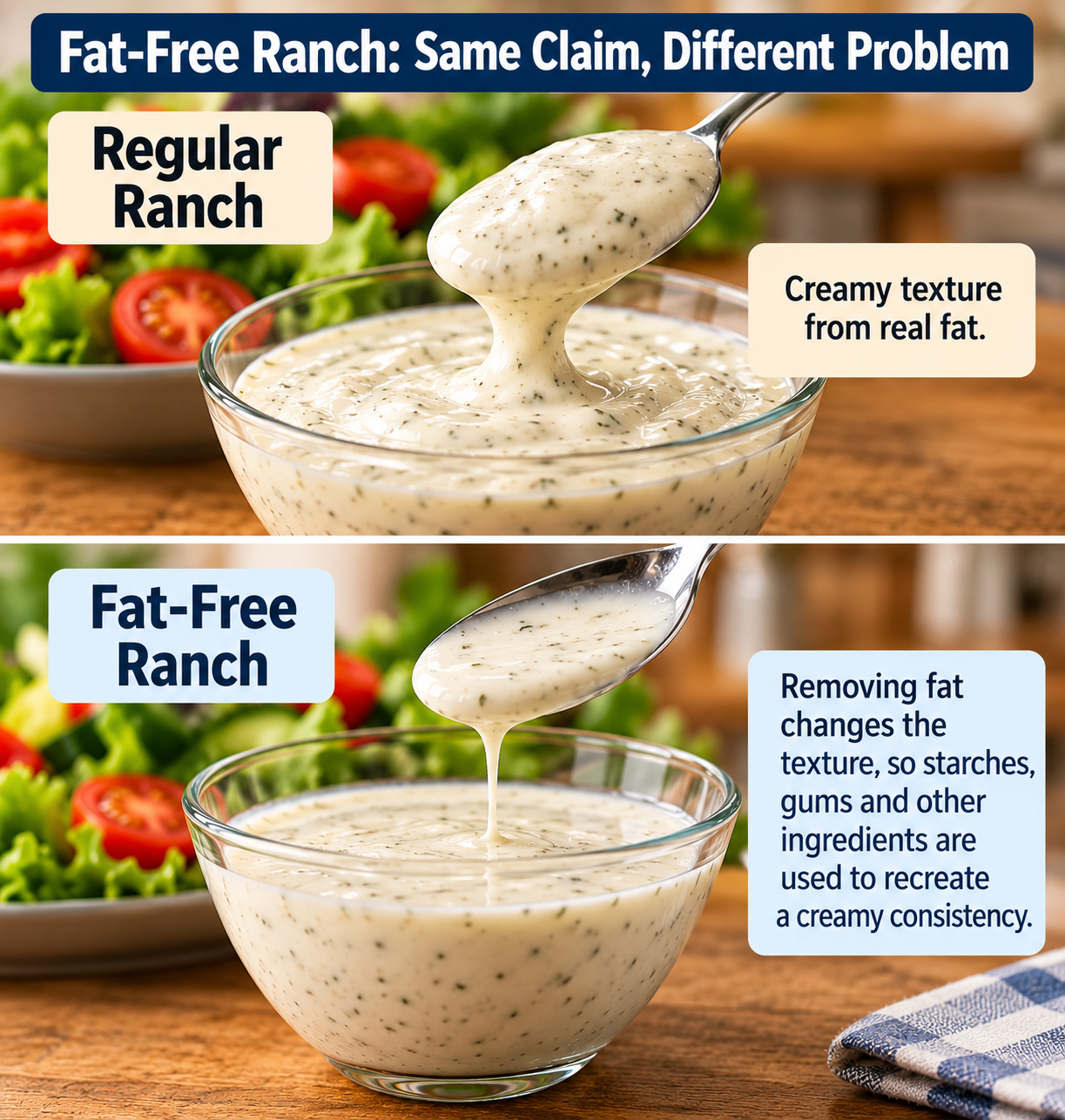
Regular ranch gets much of its characteristic creamy body from fat-containing ingredients. In a fat-free version, that physical change still has to be dealt with. Hidden Valley Fat Free Ranch uses ingredients including corn syrup, maltodextrin, modified cornstarch and xanthan gum in its formulation.
Sometimes They Really Do Just Take Something Out
Fat-free milk gives us an important counterexample.
Whole milk and fat-free milk are much closer relatives than regular and fat-free ranch dressing. Milk fat can be physically separated from milk without reconstructing what remains with starches, gums or other ingredients.
Horizon Organic Whole Milk provides 8 grams of fat, 13 grams of carbohydrate and 8 grams of protein per cup. Its fat-free milk has 0 grams of fat, while carbohydrate and protein remain essentially the same.
So even the same claim — fat free — can describe two very different changes to a food.
With ranch dressing, removing fat changes the physical properties of the product enough that other ingredients help rebuild its texture. With milk, much of the fat can simply be removed.
Sometimes the answer to “What did they put back in?” is surprisingly simple:
Nothing much.
Zero Sugar: Here We Can Watch a Replacement Happen
Chocolate syrup gives us another version of the story.
Regular Hershey's Chocolate Syrup gets its sweetness primarily from high-fructose corn syrup, corn syrup and sugar. One tablespoon contains about 45 calories, 12 grams of carbohydrate and 10 grams of added sugar.
Hershey's Zero Sugar Chocolate Syrup uses a different system. Its ingredients include glycerin and erythritol, along with acesulfame potassium and sucralose. One tablespoon contains about 5 calories, 2 grams of carbohydrate, no sugar and 2 grams of sugar alcohol.
Here, one way of producing sweetness really has been replaced by another.
But something else happened at the same time. Sugar fell from 10 grams to zero, while calories dropped from 45 to 5 and carbohydrate from 12 grams to 2.
That makes this more interesting than a simple story about manufacturers taking something out and sneaking something undesirable back in. The reformulation changed several things a person choosing zero sugar might care about.
Now compare that with another zero-sugar product.
Hershey's Zero Sugar Chocolate with Almonds contains no sugar, but four pieces still provide about 140 calories, 19 grams of carbohydrate and 15 grams of sugar alcohol.
Both products can accurately say zero sugar.
But zero sugar describes the sugar. It doesn't describe the whole food.
How Much Sodium You Remove Can Change the Solution
Chicken noodle soup gives us another wrinkle.
Campbell's regular Chicken Noodle Soup contains about 890 mg of sodium per serving. Its 25% Less Sodium version lists roughly 630 mg on the Nutrition Facts panel.
Despite that reduction, the familiar nutritional profile barely moves: about 60 calories, 2 grams of fat, 8 grams of carbohydrate and 3 grams of protein.
Then Campbell's goes further.
Its Heart Healthy Chicken Noodle Soup contains about 410 mg of sodium. At that level, potassium salt appears in the seasoning, and the soup provides substantially more potassium.
That gives us something we couldn't see from the words reduced sodium alone.
The size of the reduction matters.
Reducing sodium from about 890 mg into the 600s presents one formulation problem. Bringing it down to about 410 mg while still making recognizable chicken noodle soup presents another.
Sometimes a modest reduction requires surprisingly little change elsewhere. Push the reduction further and another ingredient may become part of the solution.
Dairy-Free Breaks the Question Completely
Put a carton of almondmilk beside a carton of dairy milk and they appear to belong together. We pour them over cereal, add them to coffee, use them in recipes and store them in the same part of the refrigerator.
But nobody took cow's milk and removed the dairy.
Almondmilk started as a different food.
Now we aren't asking what replaced a missing ingredient. We're asking what happens when one food is used to perform some of the jobs of another.
Protein makes the distinction particularly easy to see.
A cup of dairy milk typically provides about 8 grams of protein. A cup of unsweetened almondmilk can provide only about 1 gram.
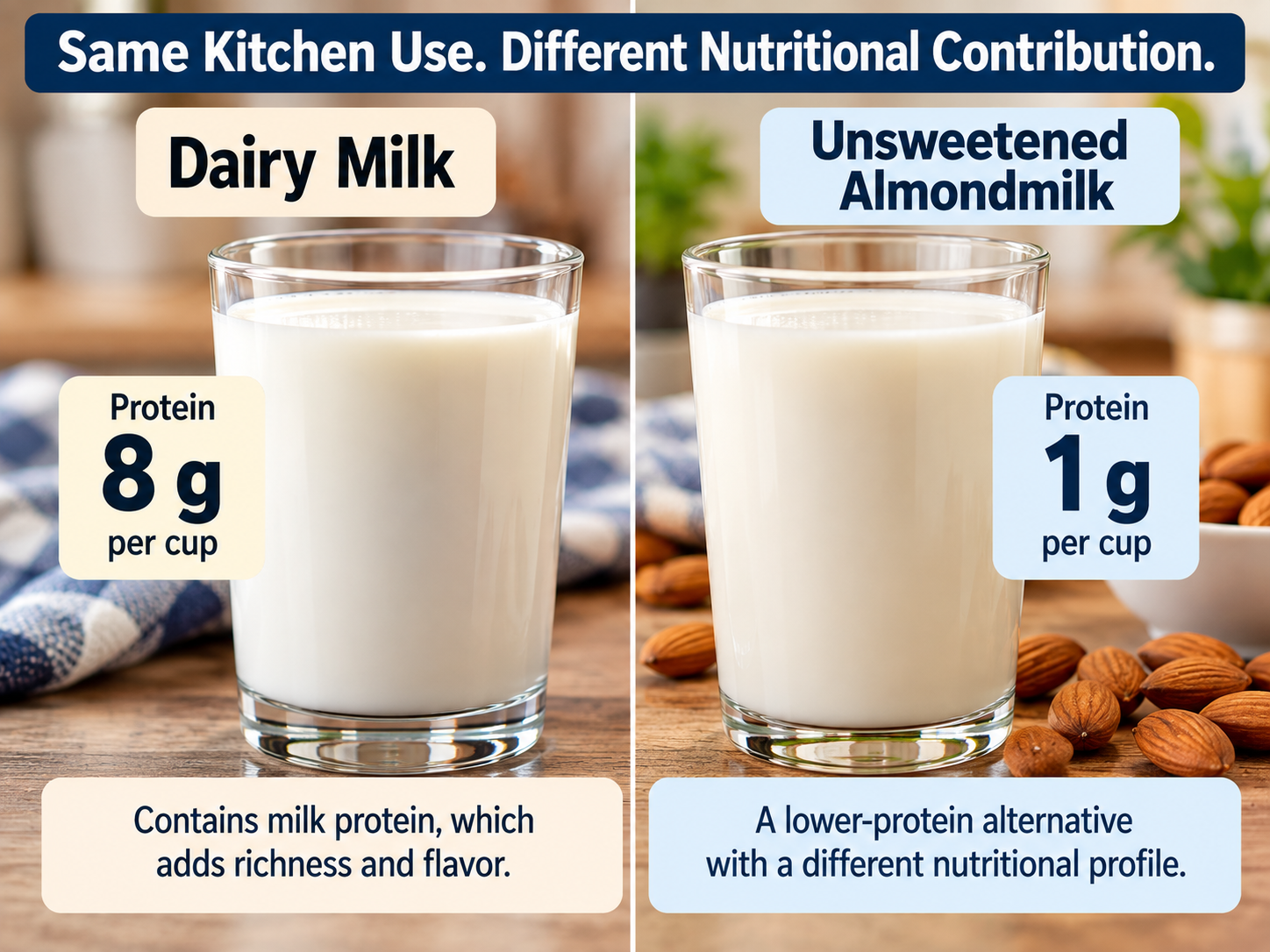
If you add a splash to coffee, that difference may mean very little.
If you drink two cups of milk a day and count on it as part of your protein intake, substituting this almondmilk changes your day by about 14 grams of protein.
Protein isn't the whole story, either. Many almond beverages are fortified with calcium and vitamins, and their carbohydrate, sugar and saturated-fat profiles can differ considerably from dairy milk.
So what is a “milk alternative”?
That depends partly on what you expected the milk to do for you.
Two foods can perform the same kitchen job without performing the same nutritional job.
And sometimes the question isn't “What did they put back in?”
It's “What did I stop getting when I made the switch?”
Five Labels. Several Very Different Stories.
We started with a simple question. The packages gave us several answers.
With gluten-free bread, part of the physical architecture disappears, so several ingredients may help create a workable loaf.
With fat-free ranch, removing fat changes the physical properties of the food and requires more reformulation. With fat-free milk, the fat can be separated while much of the remaining nutritional profile stays remarkably similar.
With zero-sugar syrup, one sweetening system is replaced by another, while calories and carbohydrate can change substantially too.
With reduced-sodium soup, how far the manufacturer lowers the sodium can affect what else has to change.
And with almondmilk, nothing was removed from dairy milk at all. One food was substituted for another.
Those are not variations on one simple replacement story.
You Don't Need to Investigate Every Package
There is an unfortunate way to use everything you've just read: you could start standing in supermarket aisles scrutinizing every nutrient, every ingredient and every unfamiliar word.
That isn't necessary.
Start with the reason you picked up the product.
If you need gluten-free bread, make sure it meets that need. If carbohydrate also matters to you, check carbohydrate and fiber.
If you're reducing sodium, compare sodium. If the lower-sodium version gives you the reduction you want and nothing else important to you changed, you have your answer.
When you're substituting an entirely different food, think about what the original contributed to your diet. That's when protein, fiber, calcium or another nutrient may deserve a second look.
Compare what matters to you, and stop when you have your answer.
One Claim Is Never the Whole Food
The most interesting thing about these labels may not be what manufacturers put on the package.
It may be what we add in our own heads.
Gluten-free can start to sound like a description of the bread's overall nutrition. Fat-free can start to sound like a description of the entire formulation. Zero sugar can start to sound like low carbohydrate or low calorie. Dairy-free can start to sound like nutritionally equivalent milk without the dairy.
None of those conclusions is contained in the claim itself.
The claim gives you one piece of information. Sometimes that's all you need. Sometimes it gives you a reason to turn the package around.
And every once in a while, doing that reveals something much more interesting than whether the product belongs in your cart.
It shows you how food actually works.
A Note from Marsha
This Guide started with a simple assumption I had carried around for years: when manufacturers take something out of a food, they usually have to put something else back in.
Once I started looking at actual products, that idea didn't hold up nearly as neatly as I expected. Sometimes something is replaced. Sometimes several ingredients have to take over different jobs. Sometimes very little changes.
And sometimes, as with almond milk, we're actually comparing two different foods rather than a food with something removed.
That's what made this worth writing about for me. A few words on the front of a package can make something sound simple. Turn the package around, and the story can be much more interesting.

Where You Might Want To Go Next
Is Jerky Healthy? Preservation, Protein, and the Trade-Offs We Choose
Another look behind a food label. Jerky shows how changing a food to solve one problem - preservation creates other trade-offs involving sodium, processing, shelf life and food safety.
Hawaiʻi Food Safety Guide
What is in the package is only part of the food decision. This Guide looks at what happens after you buy food - handling, storage and the everyday conditions that can turn safe food into a food-safety risk.
Constipation, Gas, and Bloating: Why Your Liver May Be Involved
Food choices don't end with ingredients and nutrition labels. This article follows food into the digestive system and looks at how digestion, bile, the liver, gallbladder and intestines interact.