Resource

Understanding Your Health Insurance Costs

Why the amount billed, the amount insurance allows, and what you actually owe can be very different.

Medical bill and Explanation of Benefits displayed beside a calculator and stethoscope, illustrating the differences between provider charges, insurance payments, and patient responsibility.

You visit a specialist, undergo a medical procedure, or receive treatment at a hospital. Several weeks later, you receive a statement showing a surprisingly large charge.


Then your insurance company sends an Explanation of Benefits (EOB), showing a different amount. The insurer has approved only part of the original charge, paid some of that amount, and assigned another portion to you.


Which number represents the actual cost of your care? And how did the insurer calculate what you owe?


Understanding medical insurance requires more than knowing your deductible or copayment. You need to understand how healthcare charges are processed, how costs are divided between insurers and patients, and which expenses might remain your responsibility even when you're insured.


Why the Provider's Charge Isn't Necessarily the Price


In many businesses, the price on the invoice is the amount the customer is expected to pay. Healthcare often works differently.


A medical practice or hospital may establish a charge for a service, sometimes called the billed charge. But when the provider has a contract with your insurance company, the insurer generally has an agreed-upon payment rate for covered services.


This is commonly called the allowed amount or negotiated rate.


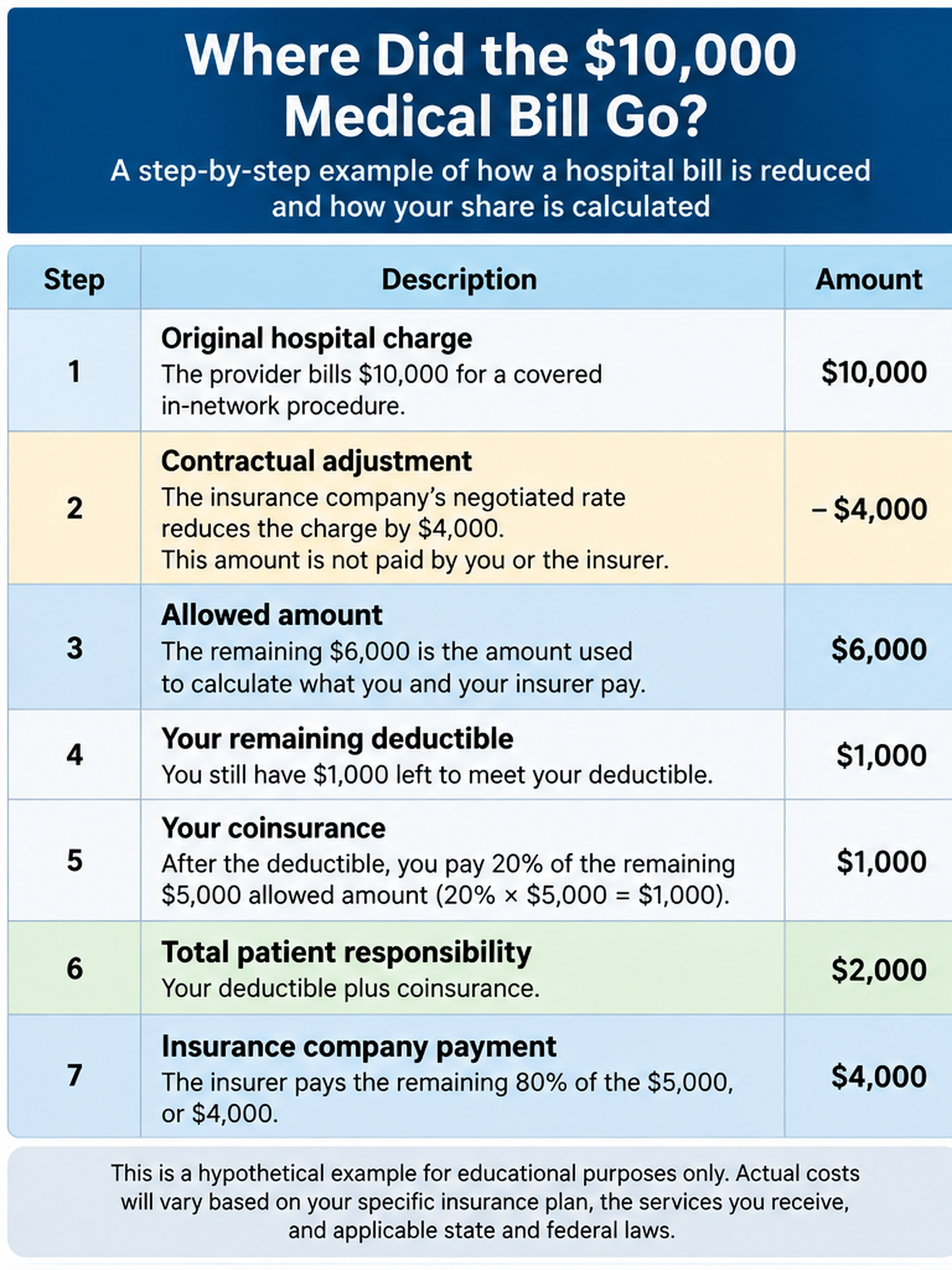
Suppose a hospital bills $10,000 for a covered outpatient procedure, but its contract with your insurance company establishes an allowed amount of $6,000.


Under the usual terms of an in-network agreement, the hospital cannot collect the additional $4,000 from you for that covered service. Instead, the difference becomes a contractual adjustment.


That doesn't mean the hospital received $10,000 and gave your insurer a $4,000 discount. It means the contracted payment arrangement is based on $6,000 rather than the original charge.


And it doesn't mean your insurance company necessarily pays the entire $6,000. Part of that amount may still be your responsibility.


How a $10,000 Medical Bill Can Become a $2,000 Patient Expense


Let's continue with the same hypothetical procedure.


Assume your insurance plan has a deductible, and you still have $1,000 remaining to meet it. After the deductible, your plan requires you to pay 20% coinsurance for this service. Assume the procedure is covered, all charges are in-network, and you haven't reached your out-of-pocket maximum.


The calculation works as follows.


A hypothetical $10,000 in-network hospital bill is reduced to a $6,000 allowed amount. A $4,000 contractual adjustment is removed, the patient pays $1,000 toward the remaining deductible plus $1,000 coinsurance, and the insurer pays $4,000.

This example reveals something that's easily missed when looking only at the original bill. The patient's responsibility is generally calculated from the allowed amount for a covered in-network service, not simply from the provider's original charge.


It also illustrates why knowing that your insurance pays 80% doesn't necessarily tell you what you'll owe. That percentage usually applies to the relevant allowed amount after deductible rules have been satisfied, not automatically to every dollar the provider bills.


And the calculation can change depending on whether you've already met your deductible, whether the service has a copayment instead of coinsurance, and whether you've reached your out-of-pocket maximum.


Deductibles, Copayments, and Coinsurance: How They Work Together


A deductible is the amount you must generally pay for certain covered services before your insurance plan begins sharing those expenses. If your annual deductible is $2,000, that doesn't necessarily mean every medical visit will be billed to you until you've paid $2,000. Some services are covered before the deductible is met, and different services may follow different rules.


A copayment is a fixed amount you pay for a covered service, such as $25 for an office visit or $50 for a specialist. Depending on the plan, a copayment might apply before or after the deductible, or certain visits may be exempt from the deductible altogether.


Coinsurance is a percentage of the allowed cost of a covered service. For example, after meeting the deductible, you might pay 20% while your insurance company pays 80%. However, you should always check which services have coinsurance and whether that percentage changes for out-of-network care.


It's also possible for a plan to have separate deductibles or cost-sharing arrangements for prescription drugs, hospital services, or out-of-network care.


The important point is that these terms don't operate independently. Your actual responsibility depends on how they interact under the rules of your particular policy.


Your Out-of-Pocket Maximum Isn't a Limit on Every Healthcare Expense


The out-of-pocket maximum is one of the most important financial protections in many health insurance plans. It's also one of the most easily misunderstood.


For a qualifying Marketplace health plan, once you've paid enough eligible deductibles, copayments, and coinsurance to reach the annual in-network out-of-pocket maximum, the plan generally pays 100% of the allowed costs of covered in-network benefits for the remainder of the plan year.


But the maximum doesn't include everything you might spend on healthcare.


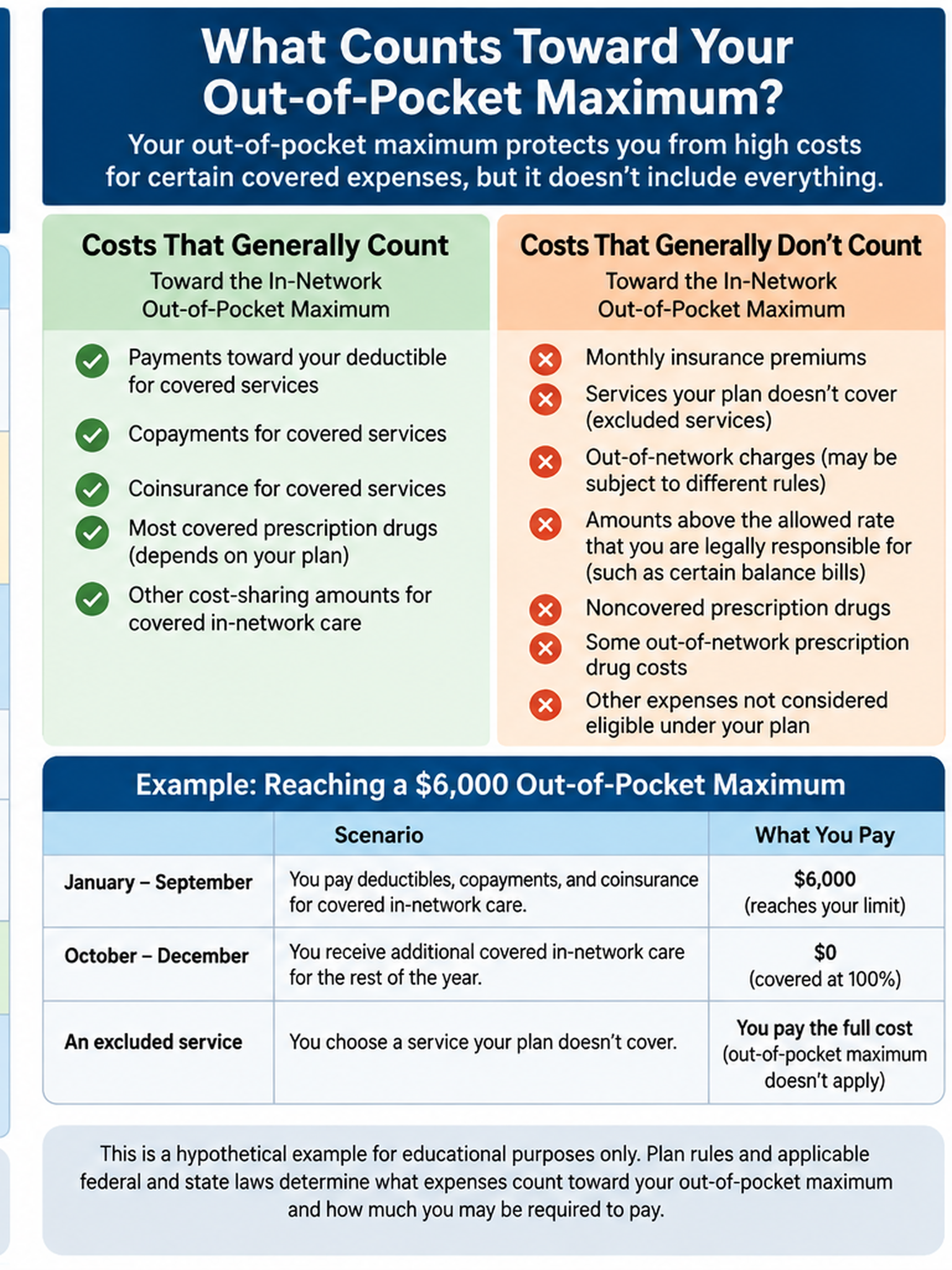
Monthly insurance premiums generally don't count toward it. Neither do costs for excluded services, and out-of-network charges may be subject to different rules. Amounts above the allowed rate that a provider is legally permitted to bill you also generally fall outside the protection.


Consider someone who reaches a $6,000 out-of-pocket maximum in September. If they receive additional covered in-network care later that year, their applicable cost-sharing may be zero. But if they choose a service the plan doesn't cover, the out-of-pocket maximum doesn't automatically make that service free.


A comparison of costs that generally count toward the in-network out-of-pocket maximum, including eligible deductible payments, copayments, and coinsurance, against expenses that generally don't count, such as premiums, excluded services, and certain out-of-network charges.

This distinction becomes especially important when someone develops a serious illness requiring extensive medical treatment. The annual limit can provide meaningful protection, but only when you understand which services and expenses qualify.


Why Being In-Network Matters Financially


Insurance companies negotiate payment arrangements with participating healthcare providers. These arrangements affect not only what the insurer pays, but also what the provider can charge the patient for covered services.


An in-network provider generally agrees to accept the applicable contracted payment arrangement, including the patient's deductible, copayment, or coinsurance, as payment under the contract.


An out-of-network provider may not have agreed to those limitations. Depending on your insurance plan, the provider may be able to bill you for the difference between the original charge and the insurer's allowed payment amount. This practice is known as balance billing.


For example, if a provider charges $1,000 and your insurer recognizes only $600, you could potentially face a $400 difference in addition to applicable cost-sharing, unless your contract or the law protects you from that charge.


Federal and state laws provide important protections in certain situations. The federal No Surprises Act, for instance, restricts many unexpected out-of-network bills involving emergency services and certain services provided at in-network facilities.


But these protections don't apply to every out-of-network service. Before arranging nonemergency care, it's worth confirming the network status of both the facility and the professionals involved.


Does a More Expensive Insurance Plan Save You Money?


Not necessarily.


A plan with a higher monthly premium may have a lower deductible, smaller copayments, or lower coinsurance. That can be advantageous for someone who expects substantial medical expenses.


But someone who rarely needs medical care may spend more on annual premiums than they save through lower cost-sharing.


To evaluate the difference, you need to consider more than the monthly premium. The annual premium, deductible, out-of-pocket maximum, provider network, prescription coverage, and expected medical needs all matter.


The comparison becomes more complicated when one plan has higher premiums but a significantly lower financial limit for covered services.


We will examine how to compare these trade-offs in a separate Guide. For now, the important principle is that the least expensive insurance plan to purchase isn't necessarily the least expensive plan to use.


Why Your Explanation of Benefits Matters


Your EOB is one of the most useful documents for understanding what happened to a medical claim.


Although formats differ, an EOB generally identifies the provider, the services processed, the amount billed, the amount allowed, the insurer's payment, and the amount assigned to the patient.


It's important to remember that an EOB isn't a request for payment. It's a record of how the insurer processed a claim.

When the provider sends a bill, compare that bill with the patient responsibility shown on the EOB. The amounts should generally be consistent after accounting for payments, adjustments, and any claims still being processed.


If the numbers don't make sense, contact the provider's billing office or the insurer before assuming the bill is correct. A claim can be processed incorrectly, an adjustment can be missing, or the provider may not yet have recorded the insurer's payment.


Understanding your EOB can help you identify discrepancies before they become larger financial problems.


Five Questions Worth Asking Before Expensive Medical Care


When time permits, particularly before nonemergency treatment, ask your insurer and healthcare provider for information about the expected costs.


Find out whether the service is covered under your plan and whether prior authorization is necessary. Confirm that the provider and facility are in-network, and ask what deductible, copayment, or coinsurance rules apply.


You can also request an estimate of your share of the allowed cost and determine how much of your annual deductible and out-of-pocket maximum you've already satisfied.


These estimates aren't guarantees of the final bill. Additional services, coding differences, changes in treatment, and other factors can affect the amount.


Still, asking these questions before treatment gives you an opportunity to identify potential financial problems rather than discovering them only after receiving a bill.


The Numbers Tell Only Part of the Story


Healthcare bills can be confusing because the amount charged for a service isn't necessarily the amount used to calculate insurance payment, and neither amount necessarily represents what you owe.


Once you understand the relationships between billed charges, negotiated rates, deductibles, copayments, coinsurance, and out-of-pocket limits, insurance statements become easier to interpret.


That knowledge won't eliminate every billing problem or unexpected expense. But it can help you identify errors, question unfamiliar charges, and better understand the financial commitments associated with your healthcare.


The most useful question isn't simply, "How much did the provider charge?" It's, "How much am I actually responsible for under my insurance plan, and why?


Sources and Further Reading


Note from Marsha


My background as a CPA included working with the financial side of medical practices, where billed charges, insurance allowances, and actual payments could be very different.


I've always thought that understanding the numbers gives people a better position from which to ask questions. Medical insurance is no exception.


Many people assume the number on a medical bill is the amount they are expected to pay, but insurance often works very differently. I think understanding that difference can reduce confusion and help people recognize when a bill or statement deserves a closer look.


I hope this Resource makes those numbers less mysterious and helps you recognize when a bill deserves a closer look.

Where You Might Want to Go Next


Health Insurance Denials: Who Bears the Cost of Fighting Back?

Explore why insurers deny claims and who carries the burden of challenging their decisions.


What to Do When Your Health Insurance Denies Care or Payment

Follow a practical Guide to understanding a denial, finding assistance, and protecting your appeal rights.


How to Compare Health Insurance Plans

Learn how to evaluate premiums, deductibles, networks, and potential healthcare expenses before selecting coverage.


The first two companion articles are published. The insurance comparison Guide is planned.