

Health Resource
Normal Liver Enzymes: What Can They Miss?
What AST and ALT can tell you, what they cannot establish, and when a closer look may be appropriate
Your routine blood work comes back, and your AST and ALT results fall within the laboratory’s normal range. That is encouraging.
But what did those results actually establish?
AST and ALT are enzymes that may enter your bloodstream when liver cells are injured. Normal results mean that the tests did not detect an unusual elevation at that time. They do not measure the amount of fat in your liver, and they do not directly measure inflammation or fibrosis, which is liver scarring.
Normal liver enzymes are good news. They are not always the complete answer.
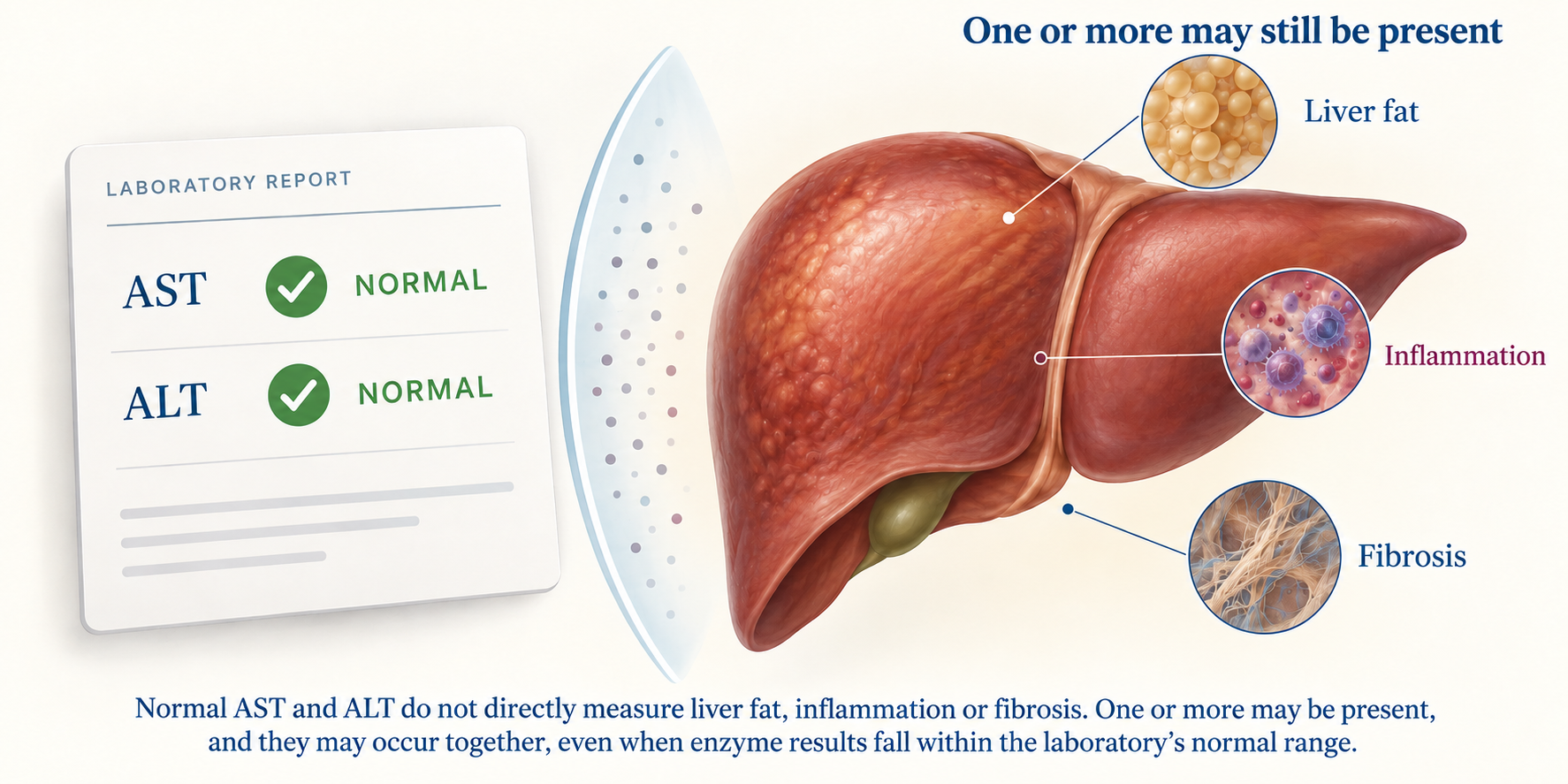
What may be hiding behind normal results?
Metabolic fatty liver disease can develop with few or no obvious symptoms. AST and ALT may remain normal even when liver fat, inflammation or fibrosis is present. This can occur across the disease spectrum, including in some cases of advanced fibrosis or cirrhosis.
The current medical name is metabolic dysfunction-associated steatotic liver disease, or MASLD. You may know it by its former name, nonalcoholic fatty liver disease, or NAFLD.
MASLD begins when excess fat accumulates in the liver in connection with metabolic risk. That risk may include type 2 diabetes, insulin resistance, abdominal obesity, high triglycerides, other lipid abnormalities or high blood pressure.
Liver fat alone does not mean that serious liver disease will follow. Fatty liver may remain stable and can sometimes improve as the underlying metabolic conditions improve.
In other cases, liver fat is accompanied by inflammation and liver-cell injury. This is called metabolic dysfunction-associated steatohepatitis, or MASH. Continued injury may lead to fibrosis and, eventually, cirrhosis.
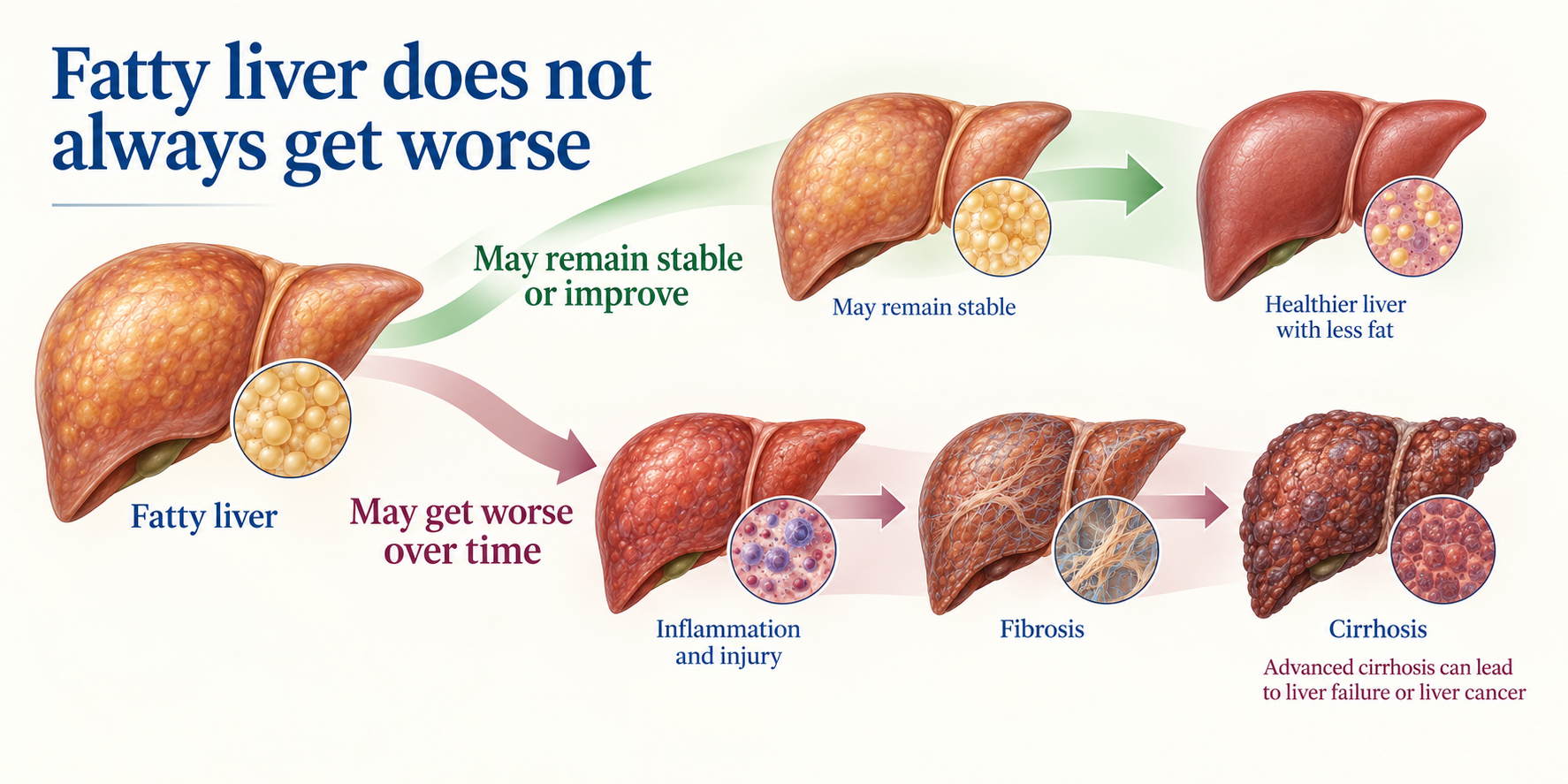
Why fibrosis matters more than fat alone
Finding fat in the liver is important. Determining whether significant fibrosis may be present is usually more important to your long-term liver health.
Fibrosis develops as the liver responds to continuing injury. As scarring becomes more extensive, it can interfere with the liver’s structure and function. Advanced fibrosis and cirrhosis carry much greater risks than liver fat alone.
This means your PCP may need to consider two different questions:
- Is there excess fat in your liver?
- Is there evidence that significant fibrosis may be present?
A single routine test may not answer both questions.
When normal enzymes may provide too much reassurance
A closer discussion may be appropriate if you have:
- Type 2 diabetes
- A previous diagnosis of fatty liver
- Abdominal obesity
- High triglycerides or other lipid abnormalities
- High blood pressure
- Insulin resistance
- Several metabolic risk factors
- Regular alcohol consumption, especially when combined with metabolic dysfunction
Alcohol and metabolic risk can affect the liver together. The cause of liver injury does not always fit neatly into a purely metabolic or purely alcohol-related category.
MASLD is also closely associated with cardiovascular disease, type 2 diabetes and chronic kidney disease. These conditions have several risk factors in common. Their association does not prove that fatty liver independently causes every related condition, but it does mean that liver health should not be considered in isolation.
How can your PCP look beyond AST and ALT?
You do not need to choose your own tests or manage the testing sequence. Different assessments answer different questions, and your PCP can decide what is appropriate based on your history.
An earlier ultrasound, CT or MRI report may already mention fat in your liver. A standard ultrasound can detect liver fat, but it may miss milder accumulation and cannot reliably determine the stage of fibrosis.
Your PCP may also calculate
FIB-4 using information that may already be in your medical record:
- Your age
- AST
- ALT
- Platelet count
FIB-4 does not diagnose fatty liver and does not measure liver fat. It estimates whether advanced fibrosis appears unlikely or whether another assessment may be appropriate.
Age affects its interpretation. The calculation is less reliable in adults under 35, while a different threshold is generally used for adults over 65. FIB-4 should therefore be interpreted by a clinician rather than treated as a verdict.
If fibrosis risk is not clearly low, your PCP may consider a FibroScan, the Enhanced Liver Fibrosis blood test known as ELF, magnetic resonance elastography or referral to a gastroenterologist or liver specialist.
FibroScan can estimate liver stiffness, which may indicate fibrosis. It can also estimate liver fat. Magnetic resonance methods can provide additional information when earlier results are uncertain, but they are not the first step everyone needs.
What should you ask your PCP?
If you have type 2 diabetes, known fatty liver or several metabolic risk factors, contact your PCP and ask:
“My liver enzymes are normal, but given my metabolic risk, should I be assessed for fatty liver or liver fibrosis?”
That is enough to begin the conversation.
Your PCP can determine whether the next step should involve reviewing earlier imaging, calculating FIB-4 from existing laboratory results, ordering another assessment or referring you for additional evaluation.
The purpose is not to request every available test. It is to make sure normal AST and ALT results have not ended the inquiry too soon when your health history suggests that a closer look may be reasonable.
What can help if fatty liver is found?
The appropriate plan depends on what is found and on the metabolic conditions contributing to it.
Weight loss itself can substantially reduce liver fat. However, a small controlled study suggests that diet composition may also influence how the liver responds. Three groups lost approximately 10% of their body weight on ketogenic, Mediterranean or very-low-fat plant-forward diets. All three experienced metabolic improvements, but the ketogenic group had a greater short-term reduction in liver fat and a larger improvement in liver insulin sensitivity. Because the study was small, highly controlled and relatively short, it does not establish one diet as the best long-term choice.
Your plan may include improving blood sugar management, treating high blood pressure and lipid abnormalities, increasing physical activity, reducing excess weight when appropriate and discussing alcohol use with your PCP.
Your medications, nutritional needs, muscle mass and ability to exercise should all be considered. Prescription treatments are also available for selected adults with MASH and moderate-to-advanced fibrosis, but they are not intended for everyone with liver fat.
A liver cleanse does not provide an assessment
A cleanse or supplement marketed for “liver support” cannot tell you whether liver fat, inflammation or fibrosis is present.
Some supplements can also injure the liver or interact with medications. Before taking a product marketed for liver health, discuss it with your PCP or pharmacist.
If you are concerned enough about your liver to purchase a cleanse, you are concerned enough to ask whether your liver has been properly assessed.
The question behind the normal result
Normal AST and ALT results should not be turned into bad news. They are encouraging.
The problem begins when they are interpreted as proof that no meaningful liver condition could be present.
If you have little metabolic risk, no history of fatty liver and no other reason for concern, your PCP may decide that no further assessment is needed. If you have type 2 diabetes, known fatty liver or several metabolic risk factors, the same normal results may need to be considered within a larger picture.
The question is not only whether your liver enzymes are normal.
The better question is whether your health history gives your PCP a reason to look further.
Sources:
- American Association for the Study of Liver Diseases. AASLD Practice Guidance on the Clinical Assessment and Management of Nonalcoholic Fatty Liver Disease. Hepatology. 2023.
- American Association for the Study of Liver Diseases. Steatotic-What? Changes in Fatty Liver Nomenclature. 2023.
- Petersen MC, Smith GI, Farabi SS, et al. Effect of Diet Macronutrient Content on the Cardiometabolic Response to Weight Loss: A Randomized Clinical Trial. Cell Metabolism. 2026.
- National Institute of Diabetes and Digestive and Kidney Diseases. Diagnosis of NAFLD and NASH.
- National Institute of Diabetes and Digestive and Kidney Diseases. Fatty Liver Disease: An Underdiagnosed Complication of Type 2 Diabetes.
- U.S. Food and Drug Administration. FDA Approves First Treatment for Patients with Liver Scarring Due to Fatty Liver Disease. 2024.
- U.S. Food and Drug Administration. Wegovy Prescribing Information Including the MASH Indication. 2025.