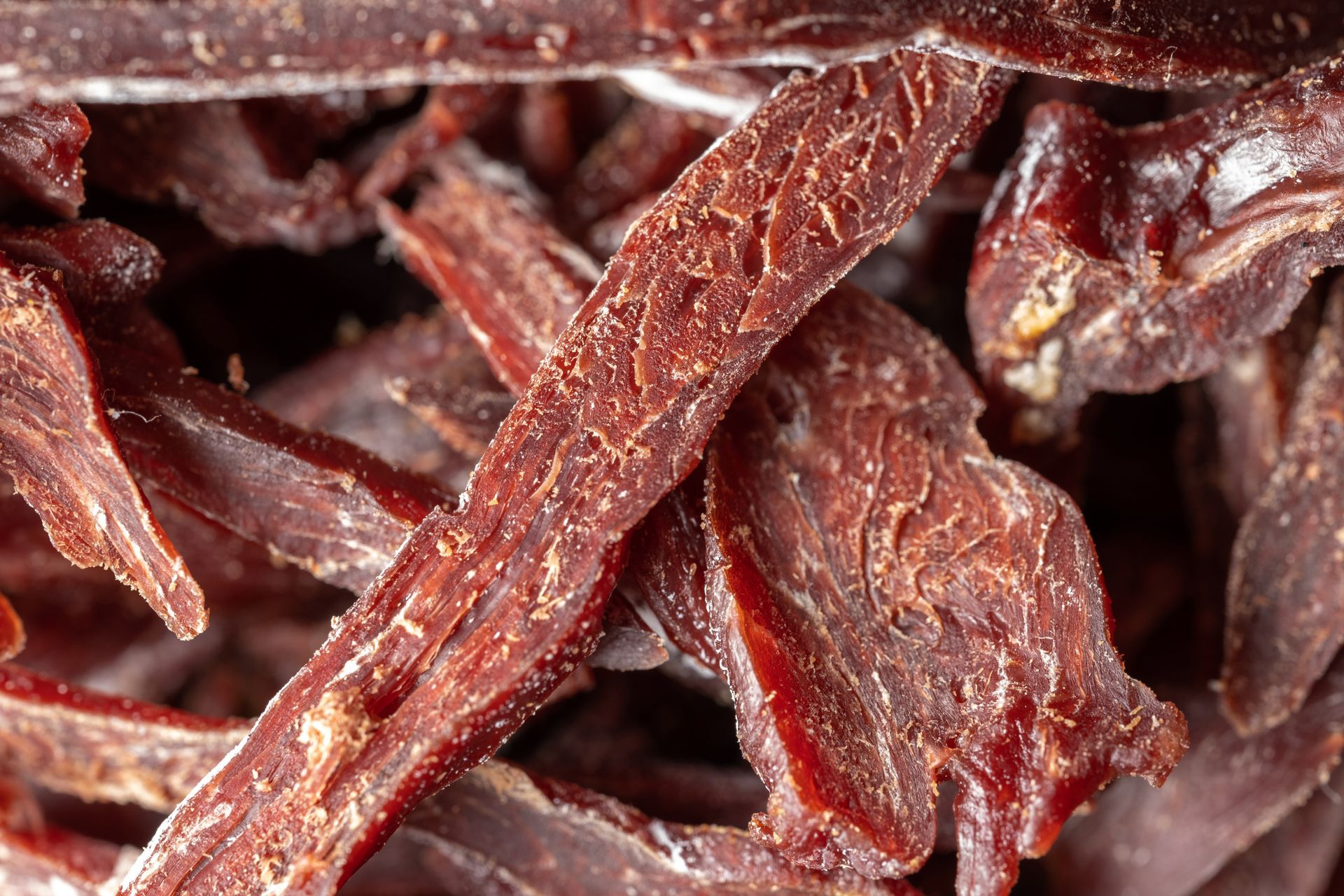
Harvard Chan Magazine recently revisited a familiar question: Is jerky healthy? The nutrition experts quoted offered a measured response. Jerky provides concentrated protein and often contains relatively recognizable ingredients. It can also be high in sodium, may contain added sugars, and in many cases includes nitrates or nitrites. Occasional consumption is reasonable. Regular reliance is more complicated.
That answer is accurate — but incomplete. The deeper issue is not whether jerky is good or bad. It is what problem jerky is solving, and what trade-offs are built into that solution.
Jerky Solves a Storage Problem
Fresh meat is biologically unstable. It contains moisture, nutrients, and a neutral pH environment that bacteria readily use to multiply. Without refrigeration, it spoils quickly.
Drying meat transforms it into something more stable by reducing the conditions microbes need to grow. Historically, this was not a lifestyle choice. It was survival.
Across cultures, dried meats were developed to endure:
- Winter scarcity when fresh hunting was limited
- Long travel or migration
- Military campaigns or trade routes
- Regions without reliable refrigeration
These products were preservation tools. They were not everyday convenience snacks in environments of abundance.
That historical context matters. It reminds us that jerky was originally engineered to extend survival, not to serve as a daily protein default.
What Actually Makes Dried Meat Safer
Drying does not make meat “clean.” It makes it less hospitable to microbial growth.
Microorganisms require three conditions to multiply:
- Sufficient moisture
- Time
- Favorable temperature
Drying reduces available water. When moisture drops low enough, bacterial growth slows dramatically. This is why jerky works as a preservation method.
Heat is also critical. For beef, internal temperatures should reach at least
160°F before or during drying to reduce pathogen risk, particularly from organisms such as E. coli or Salmonella. Drying without adequate heating may limit growth, but it does not reliably eliminate existing pathogens.
In other words, safety depends on:
- Adequate heat
- Meaningful moisture reduction
- Proper storage conditions
It is not achieved by ingredients alone.
Commercial Jerky: Engineered Shelf Stability
Commercial jerky is designed around long shelf life. That requires controlled systems.
Manufacturers typically use:
- Validated heat processes to reduce pathogen load
- Measured moisture levels and water activity targets
- Oxygen-limiting packaging
- Higher sodium levels to assist preservation
- Sometimes nitrites or nitrates for microbial inhibition and color stability
When purchasing commercial jerky, the consumer is accepting the manufacturer’s safety model. The product is designed to sit unrefrigerated for months. Risk management is largely outsourced.
The trade-off is that shelf stability often comes with:
- Elevated sodium intake
- Exposure to curing agents that remain debated in long-term cancer risk discussions
- A product designed for storage rather than freshness
Commercial systems prioritize consistency and durability.
Homemade Jerky: Ingredient Control and Assumed Responsibility
Homemade jerky shifts the equation.
The person making it controls:
- The cut of meat and visible fat trimming
- Whether salt levels are reduced
- Whether curing agents are omitted
- Batch size and storage duration
Many people prefer this ingredient control. But removing industrial safeguards transfers responsibility.
Safety now depends on:
- Achieving adequate heating
- Thorough drying sufficient to reduce moisture
- Limiting room-temperature holding time
- Refrigeration or freezing rather than extended pantry storage
- Shorter storage periods overall
Homemade jerky is rarely designed for months of shelf stability. It is generally safer when treated as a refrigerated or frozen product.
Removing preservatives does not remove risk. It changes how risk is managed.
The Sodium and Preservation Tension
Salt serves two purposes:
- It enhances flavor.
- It reduces available moisture and slows microbial growth.
Lower-salt versions may better support blood pressure goals. However, lower salt reduces passive preservation, increasing reliance on temperature control and storage discipline.
This illustrates a broader principle: preservation methods interact with metabolic goals. Adjusting one variable often shifts responsibility elsewhere.